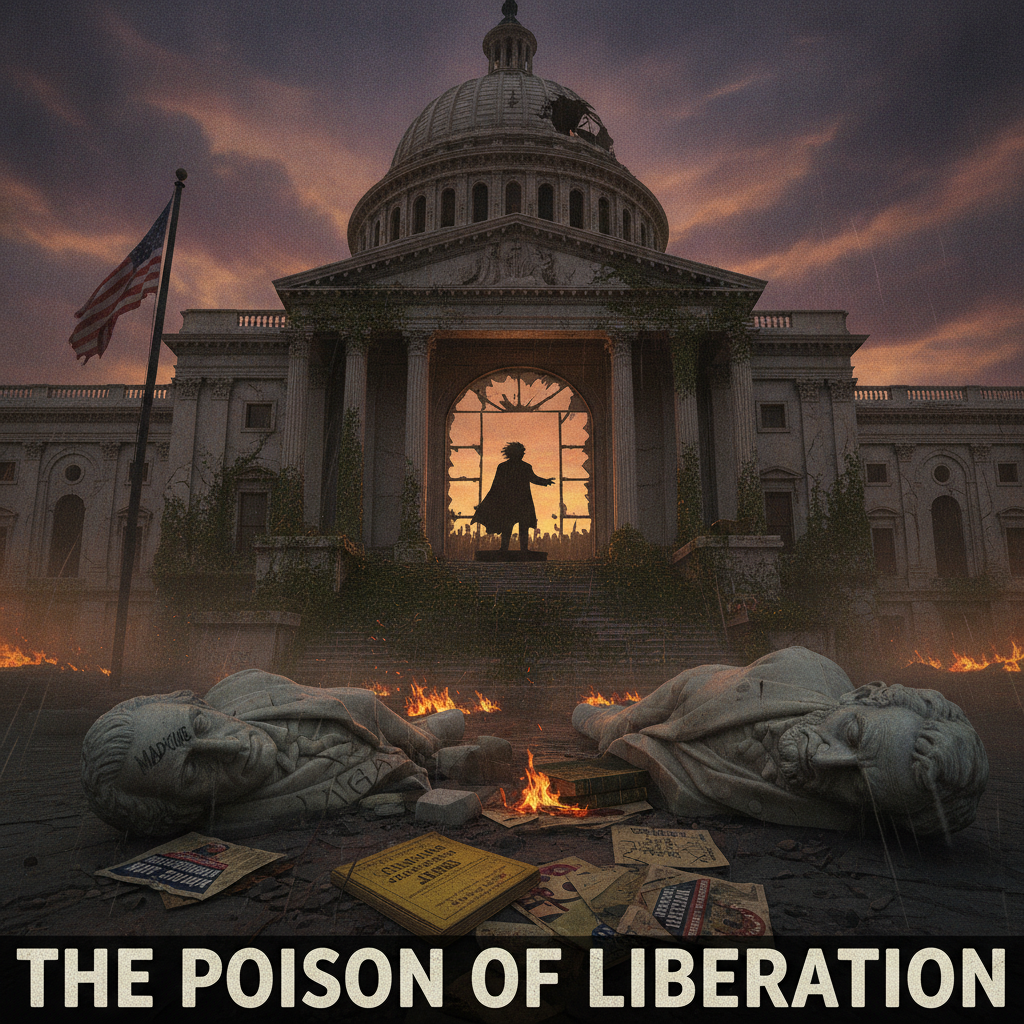
At its 250th anniversary, the United States is in a state of self-destruction, returning to the problematic origins of its founding, including greed and a glorification of mob violence. The article argues that America's ingrained 'exceptionalism' prevents it from confronting its decline, as it increasingly looks backward, drinking its own 'poison' from the revolutionary era.
The article argues that the 250th anniversary of the Declaration of Independence finds the United States in a moment of profound embarrassment and self-destruction, having elected a 'mad king' reminiscent of the monarchy it overthrew. The author, having interviewed experts for a book on civil war, reflects on the mystery of America's decline, tracing its roots from the 2008 financial crisis to earlier historical points like 1980, 1876, or even the Civil War. However, it's asserted that the crisis has been present 'from the beginning,' with figures like George Washington and Abraham Lincoln predicting the nation's potential for self-destruction through hyperpartisanship and internal conflict. The 'American experiment has ended,' prompting a re-evaluation of its origins. The article notes the 'intellectual whiplash' in understanding US history, citing both the iconoclasm of 2020 (statue tearing) and conservative curriculum rewrites in states like Florida and Texas. It critiques these as agenda-driven 'vibes' rather than serious historical accounts. Ken Burns' documentary on the American Revolution is mentioned for portraying the founders as complex men, a 'stew of ideals and venality,' rather than simplistic heroes or monsters, highlighting contradictions like their pursuit of liberty while practicing slavery. The unique aspect of the US founding, the piece contends, was its ability to transform violence and idealism into a powerful mythology of 'American exceptionalism'—a deep-seated belief in the nation's unique greatness. As the US experiences political, economic, and social decline, it has become increasingly backward-looking, clinging to this exceptionalism in a 'doomed quest.' This nostalgia warps its politics, evident in the dominance of originalism in the legal system and Donald Trump's 'Make America Great Again' slogan, which is seen as consistent with a revolutionary country where patriotism was defined by the violent overthrow of established order. The article provocatively suggests the Revolution's motives were largely rooted in 'pure greed' (e.g., halting continental expansion, land speculation) and celebrated mob violence (tarring and feathering). It draws parallels between the entitlement of the founding fathers and modern political rhetoric, arguing that Americans are addicted not to liberty itself, but to the 'sense of liberation' and the 'poison' of mob violence as a foundational political good. The author concludes that the US is 'drinking its own poison' and dying, while its persistent exceptionalism leads it to destroy itself in a misguided attempt to 'save it,' as exemplified by its foreign policy. The nation is depicted as undergoing an 'atavistic dissolution,' rendering its Constitution meaningless and tearing itself down.