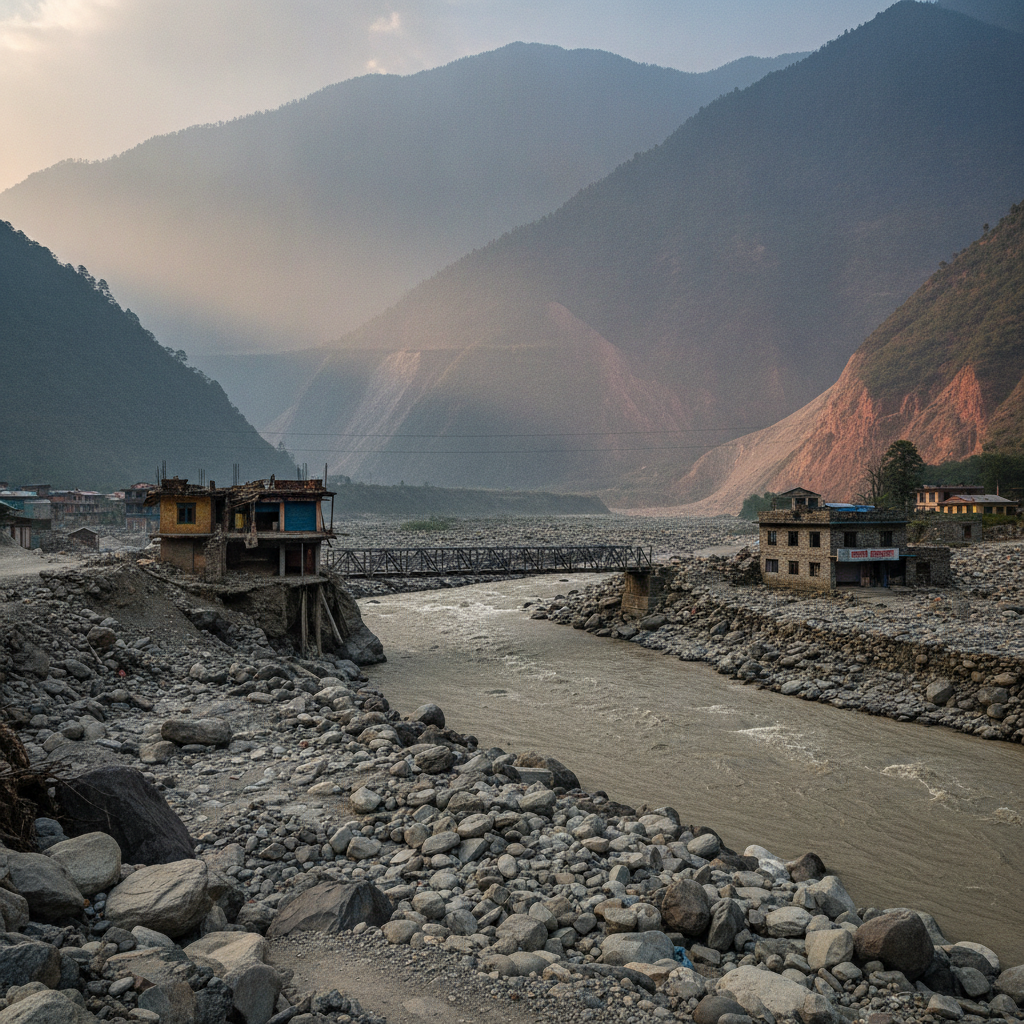
An economist recounts the devastating 2026 glacial flood in Nepal that erased his beloved town of Syabru Besi and a 45-mile corridor. The disaster, which killed over 1,300, destroyed critical infrastructure, trade routes, and hydropower projects, highlighting Nepal's vulnerability to escalating climate change impacts and the reversal of poverty reduction efforts.
For 11 years I stayed in the same hotel during my visits to Syabru Besi, a small Nepali town that sat high on a ridge where the trail to the Langtang Valley begins. Langtang is one of Nepal’s most beautiful trekking routes, a path that climbs until the valley opens up and the mountains fill every direction, close enough to feel like you could reach out and touch them. In all that time, the hotel room never changed, and neither did the sound. At night I could hear the Trishuli River, but I could never see it. It ran down the gorge, far below the village. Just to catch a glimpse of that thin silver line of water, you had to walk out to the edge of the village, lean over the ridge, and search for it. Syabru Besi held onto itself in a way almost nowhere in Nepal manages now. Same shopfronts. Same faces. There had been no coffee in the town at all on my first visit in 2014. By 2025 the hotel owner was telling me, a little proud, “Syabru has changed now, there’s a café up the road. Better coffee than anything you’ll get in the trendiest corner of Kathmandu.” There was a famous momo place, too, selling steaming hot dumplings that dripped with local flavor. On my last visit it was packed, every table taken. Syabru Besi had stopped being just a stop on the road to the mountains. It had become a small town climbing, slowly, toward something better. Then on August 31, 2026, I walked into that market and found no one. I had come this time not as a trekker but as part of a CNN team covering the disaster in Nepal. I had watched the footage. It did not prepare me. The momo restaurant still stood, the building anyway, and it was empty. The café was gone. And the hotel I had slept in for 11 years, the one where I could hear the Trishuli without ever seeing it, was not there at all. The river had taken it. The Trishuli was closer than I had seen it in all those years, having risen what looked to me like 260 feet (80 meters) or more. Never did I imagine standing in Syabru Besi with the Trishuli lapping that close to my feet. It had climbed all the way up to meet me. A 45-mile wound Syabru Besi was only where the grief started. I traveled the corridor up from Galchi toward Rasuwagadhi, past Betrawati, Mailung, Shantibazar, Timure, Trishuli Bazaar – towns with names, with shopkeepers, with morning routines. At every turn of the river the same thing had happened: both banks stripped to bare rock and gray water. Not damaged. Erased. Where houses and tea shops and bus parks had stood, there was now a riverbed giving off a bad smell, and you could hardly believe this rubble had been a living market a week before. The flood came off the China-Nepal border on the morning of 26 August. Weather stations near the border had logged little or no rain. Nepal’s Department of Hydrology and Meteorology believes a glacier snapped, triggering a landslide that formed a lake which burst its banks, throwing a wall of water and debris down the Bhotekoshi River. The glacier gave way at 8:37 that morning, according to the US Geological Survey, and within 13 minutes the flood had destroyed the river gauge at the Syabru Besi hydrological station. Not hours. Minutes. The toll is staggering and still rising. The disaster struck dozens of settlements along a 45-mile (72-kilometer) stretch of the Trishuli, killing at least 1,300 people. Some of the dead were carried 150 kilometers downstream, into India. Thousands remain missing. A government damage committee counted 7,570 buildings destroyed across five districts; the finance minister has since estimated the full reconstruction cost could reach $5 billion. Engineers, hydropower workers, customs staff and traders are among the missing, and so are people who were very close to me. I keep their faces out of this essay, because their families are still waiting, and hope is a fragile and private thing. A warning had come before. In July 2025 a flood off the Lhende River poured into this same Bhotekoshi River, killing at least nine people and tearing away the Miteri friendship bridge that ties Nepal to China. We rebuilt. A temporary Bailey bridge went up. Trade came limping back. Fourteen months later, the mountain sent something far bigger, and this time there was nothing left to rebuild. The corridor that carried the country To grasp what the Trishuli corridor was, you have to understand that, in Nepal, a road is never only a road. The Pasang Lhamu Highway, and the river running beside it, made these small towns. People came down out of the hills for the market, the connection, the opening the road gave them, and Betrawati and Trishuli Bazaar filled up with them. Opportunity built these places, and now both the opportunity and the places are gone. Downstream, the disaster sank a section of the Prithvi Highway at Krishnabhir, cutting the main artery between Kathmandu and the rest of the country, and left the whole Langtang Valley severed, some 450 people reachable only by helicopter or a two-day walk. The corridor carried the country’s northern trade as well. The Rasuwagadhi–Kerung crossing is Nepal’s largest China-facing customs point, handling roughly $563 million in imports last fiscal year: computers, machinery, electronics, garments, the goods that stock Kathmandu’s shelves before the festivals. About 19% of everything Nepal imports comes from China, and a large share of that overland flow moved through this valley. Even before August, none of Nepal’s three major China trade points were fully working. Landslides had shut Tatopani. Korala was clearing two or three trucks a day at 4,650 meters. Rasuwagadhi was still limping from the previous year’s flooding. Now the busiest of the three is a gash in the ground. Open up that one fact and the cost inside it is enormous, for traders, for prices, for a small economy that could not absorb such a loss even in a good year. We bet the country on these rivers Here is what keeps an economist like myself up at night. Nepal has wagered its future on the very water now ripping through its valleys. Hydropower, next to remittances, is one of the few genuine engines this economy has. Consider how total the wager is. Almost all of Nepal’s electricity comes from hydropower. Nepal’s installed capacity has climbed to somewhere between 3,400 and 3,900 MW, nearly all of it hydro, with more than 4,000 MW under construction and a pipeline the industry prices in the tens of billions of dollars. By 2029, installed capacity is expected to triple to almost 12,000 MW, and by 2035, the latest climate pledge could see that more than double again. Nearly every one of those megawatts sits in a river gorge like this one. And the rivers are turning on the very projects built to harness them. The flood disaster damaged or destroyed 13 hydropower projects along the Bhotekoshi and the Trishuli, knocking out 12% of the country’s total electricity capacity. Last week, as I stood beside the muddied remains of the Trishuli 3A hydropower station that had, days before, been lighting homes in Kathmandu, I thought about the rest of the projects upstream on the Bhotekoshi, the ones drawn up for basins we have not yet learned to be afraid of. If a glacial collapse can wipe out a 45-mile corridor in 13 minutes, then what are we building, and where? Civilization does not always return to the river I was raised on the idea that human civilization began on riverbanks, that water is where people gather and cities take hold. Standing in a bed of boulders where families used to sleep, I have come to believe the reverse now holds here. They are not going back. A life cannot be rebuilt on a floor of stone. For a country earning around $1,500 a head, putting Betrawati, Timure, Shantibazar and Mailung back where they physically stood is not merely hard. It cannot be done. The ground itself is gone, turned into channel. Nor does the harm stop at the flood line. The downstream markets, the ones the water only scared rather than destroyed, will carry the corridor’s death in lost trade and thinning footfall for years. So, the real question is not whether civilization comes back to the Trishuli corridor. It will not. The question is how we shield the civilizations along the other corridors, because there are so many of them. Nepal is a country of rivers, more than eight major basins, and along nearly every one of them sit towns exactly like Syabru Besi: ordinary, hopeful, set a little too near water that keeps rising. Far above them the glaciers are melting, and the lakes they feed are swelling and breaking loose. China itself warned on August 31 of a continuing risk from fresh glacier collapse along the same border, even as we were still counting our dead. What used to be a catastrophe that came once in a generation is turning into something we brace for every monsoon. Nepal’s own disaster report recorded more than 32,000 small- and large-scale disaster incidents between 2018 and 2024, roughly 5,400 a year, a curve bending the wrong way. The disaster that manufactures poverty Inside the loud catastrophe there is a quieter one, and as an economist it may be the one that frightens me most. Every disaster like this one manufactures poor Nepalis. A flood takes the house, the crop, the livestock, the shop, the savings. The family borrows to rebuild, then borrows again to eat, and by the time the next disaster lands they are weaker than they were. Nepal’s poverty rate fell from 41.8% in 1995 to about 20% by 2023, but that progress has stalled precisely as disasters have multiplied. In the late 1990s poverty was dropping by 1.36 percentage points a year. But those gains were built on remittances, not on resilient growth, and disasters are eating those gains one valley at a time. Across the last 12 years, the span that holds the 2015 earthquake and the Covid pandemic, it has crept down by just 0.41 points a year. The 2015 earthquake alone shoved as many as 982,000 people back below the poverty line. The Melamchi flood of 2021 set some in the worst-hit ward back even further, thrusting more into multidimensional poverty – poorer not just in income but in education, health and living standards. Our poverty gains were built on remittances, not on resilient growth, and disasters are eating those gains one valley at a time. The Rasuwa flood has not only ended lives. It has quietly begun turning middle-income families along the Trishuli into poor ones. And yet, what gives me hope is the resilience of ordinary Nepalis. We have come through the 2015 earthquake, the Covid years, the Gen-Z uprising, and after each blow this country has somehow risen back stronger, its people returning to their lives and their livelihoods faster than anyone had a right to expect. I stood in a riverbed that had been a town that I loved, and I still believe we will come back from this one too. But belief is not a plan, and resilience is no substitute for support. We will need it, for the families still combing the downstream banks, for the towns that must be relocated rather than rebuilt, and for a small mountain nation that did almost nothing to warm the planet now seeing its glaciers melt above its own people’s heads. Because that is the whole of it. A climate shifting faster than we are ready for. Glacial lakes filling quietly in the peaks above towns that are still asleep, towns that do not yet know their names are on a list. The dead we have already counted, and the far larger number still standing in the water’s path. Trade routes cut, an economy left exposed, an energy future we are gambling on with the risk folded quietly into the wager. I stood and watched a place I loved vanish. And I keep coming back to the one thing I cannot shake: this is a country that keeps returning to the water, for its towns, its trade, its power, its whole idea of the future, while the water keeps rising up to take it all back.