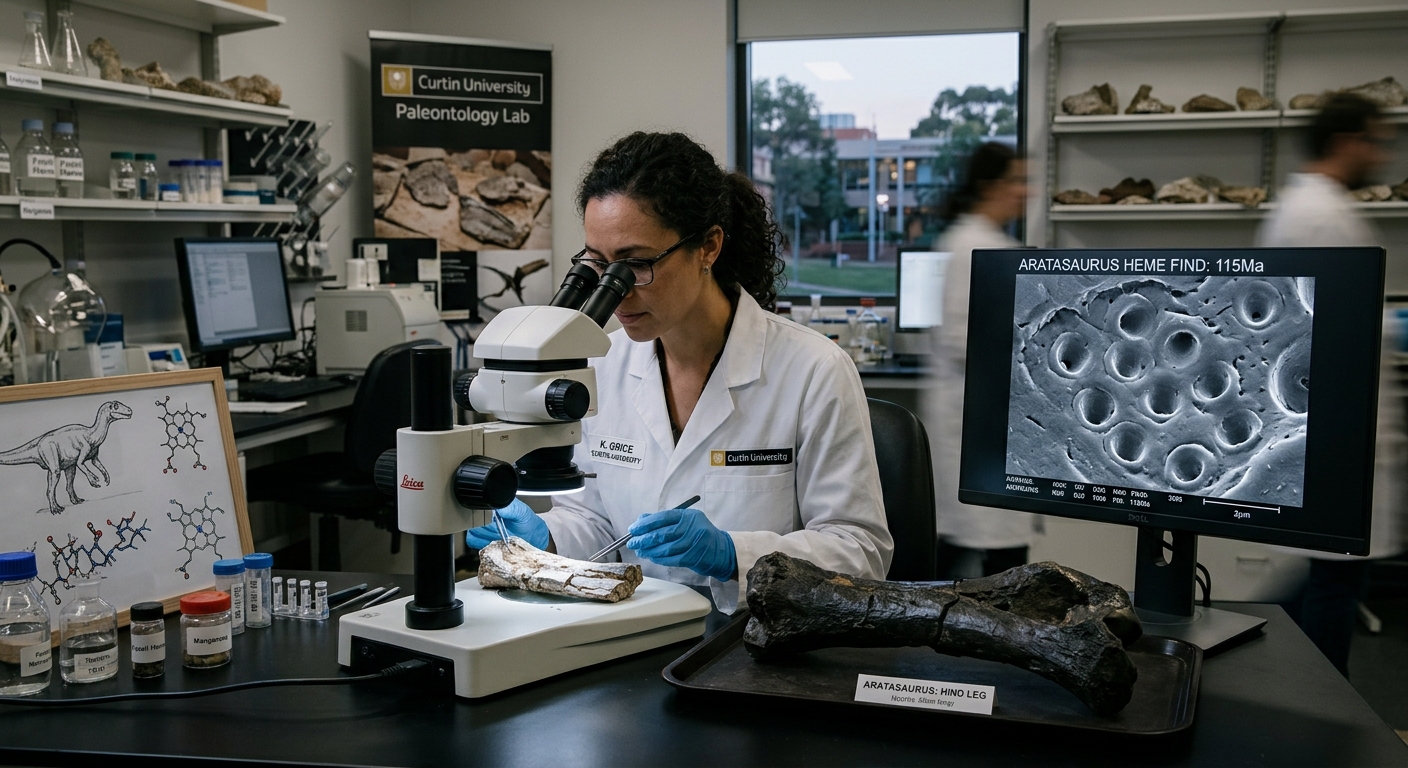
Scientists claim a groundbreaking discovery of fossilized red blood cells and heme in a 115-million-year-old Aratasaurus dinosaur bone, potentially opening new avenues for understanding dinosaur biology but igniting scientific debate.
Scientists examining the hind leg bones of a 115-million-year-old Aratasaurus dinosaur, a small meat-eater from north-eastern Brazil, claim to have discovered fossilized red blood cells and traces of heme, the organic compound crucial for oxygen transport in blood. Electron microscope images revealed small, round structures resembling red blood cells within fine channels, while chemical tests confirmed the presence of heme and amino acid building blocks for collagen. This finding, led by Prof. Kliti Grice of Curtin University, is considered a 'world first' and could revolutionize the study of dinosaur blood, metabolism, and activity levels. However, such claims are controversial due to the rapid degradation of biological tissues. Prof. Mary Schweitzer, a prominent researcher in the field, expresses skepticism about the structures being red blood cells due to their concave shape (dinosaur red blood cells typically have a 'nuclear bulge'), but is persuaded by the discovery of heme and collagen, highlighting that the conventional belief about organic material disappearing within a million years is being increasingly challenged. Grice suggests a manganese compound called hausmannite may have aided the preservation of the cells. The study, published in Proceedings of the National Academy of Sciences, prompts questions about what other biological material might exist in fossil collections globally, with Grice emphasizing the goal is not to find 'Jurassic Park DNA,' but to understand the extent of molecular preservation over deep time.