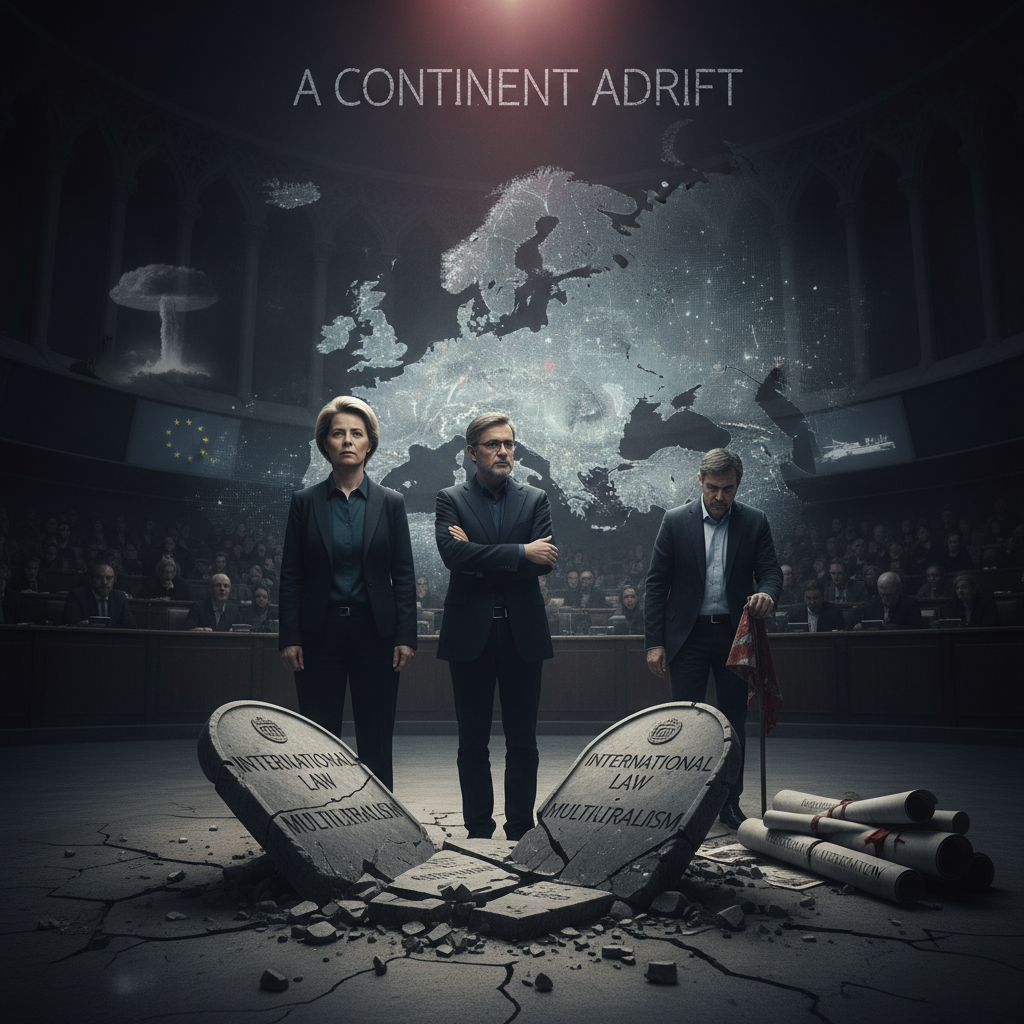
While the 2003 Iraq War, despite dividing Europe, forged a collective identity and spurred diplomatic action, the current US-Israeli war on Iran, though less divisive, is paradoxically paralyzing Europe. European leaders acknowledge the conflict's illegality but refuse to condemn it, eroding Europe's core principles of law and multilateralism, and undermining its independent global agency.
The article contrasts Europe's response to the 2003 Iraq War with its stance on the current US-Israeli war on Iran. In 2003, deep divisions across Europe over the US-led invasion paradoxically galvanized a shared European identity rooted in multilateralism and international law, leading to collective diplomatic action, such as the E3/EU+3's successful management of the Iranian nuclear file. However, today, Europe is less divided but more paralyzed. Many European leaders recognize that the US and Israeli attacks violate international law, yet they largely refrain from condemnation. Some, including Italy's Giorgia Meloni, Germany's Friedrich Merz, and European Commission President Ursula von der Leyen, have even explicitly dismissed the relevance of international law or the need to debate the war's legality, prompting contradiction from others like European Council President António Costa. This abandonment of Europe's self-proclaimed identity based on rights, law, and multilateralism is seen as hollowing out European integration from within and externally. The author argues that this 'cowardice' and 'subservience' to powers like the US and Russia is eroding Europe's collective sense of self and its ability to act independently, ultimately diminishing its sovereignty on the world stage, a stark reversal of the agency fostered by the 2003 crisis.