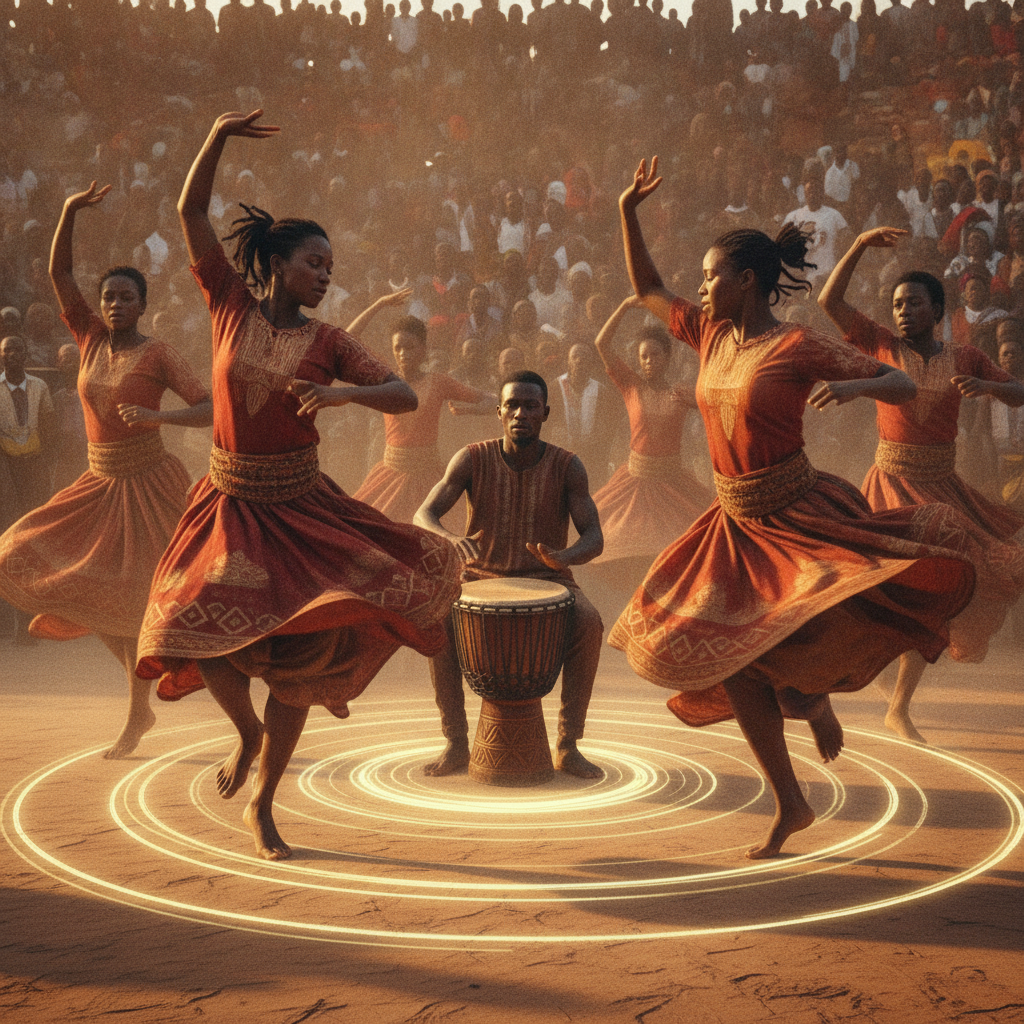
In Burkina Faso, the Fientan Company, composed of deaf and hard-of-hearing dancers, defies expectations by performing complex routines without hearing the music. They achieve this through 'Vibra-Signe,' a revolutionary technique developed by Yaya Sanou, which combines vibrations, gestures, and sign language. This method not only empowers them to dance and choreograph but also fosters inclusion, impacting audiences globally and expanding to encompass other disabilities.
For these deaf dancers, rhythm isn’t heard — it’s felt through Vibra-Signe Their limbs are a cacophony of explosive twirls as the troupe arcs seamlessly through their routine, each movement synchronized with the beat of the pounding drum. Every dancer is barefoot, yet the most remarkable absence is not their shoes but their ability to hear the drum. The deaf and hard of hearing dancers that form Fientan Company in Burkina Faso, West Africa, do not need to listen to music to feel its rhythm. Their connection circumvents the ears and instead flows through a studiously learned skill: Vibra-Signe. Blending vibrations, gestures and sign language, Vibra-Signe is a technique that equips those on the spectrum of hearing loss with the tools to not merely dance but teach others and choreograph their own routines. It is an ever-developing “gestural language” created by Yaya Sanou, a dancer, choreographer and singer from Bobo-Dioulasso, Burkina Faso’s cultural capital. Born in 1985 in a city renowned for its rich musical heritage, echoing back to the early independence days of bands like Volta Jazz in the 1960s, Sanou believes dance was his destiny. “Here we really grow up with the culture of dance, in funerals and baptisms … that’s different from other countries, where it takes a lot more work to find the right rhythm,” Sanou told CNN. “I grew up with rhythm in my body.” But Sanou is not deaf and did not grow up around deaf communities. Knowing no friends or family with hearing losses, much of his life’s work is owed not even to an interaction, but merely an observation. In 2006, Sanou routinely walked by one of Burkina Faso’s four dedicated deaf schools, L’institut des Jeunes Sourds du Faso (IJSF/Faso Institute for Young Deaf), on his way to teach local dance classes. Each time he passed the playground there was little sign of play, with groups of children often huddled together, bored and listless. Eventually, Sanou couldn’t bring himself to keep walking by. “I saw a lack of personal fulfillment. No one was offering dance, cultural activities, or sports activities,” he recalled. “That struck me, called out to me … I always use my art in service of society, that’s why I decided to go see them and offer them something.” The joy of living Sanou began running dance workshops at the school soon after, yet quickly realized he also had much to learn. Approximately 55,000 (around 0.23%) of the roughly 23.4 million-strong Burkinabé population are deaf, according to the African Sign Languages Resource Center. The predominantly used sign languages are Langue des Signes de L’Afrique Francophone (LSAF), the locally evolved Burkina Sign Language and American Sign Language (ASL), but Sanou was not versed in any of these when he started at IJSF. Yet after two years of learning on the job, often writing on the blackboard for a signing student to translate for both him and the class, he was fluent. Sign language would serve as the cornerstone of Vibra-Signe, allowing him to communicate choreography instructions to students. As hinted in the moniker, though, signing is just one building block of the technique. Vibration and connection to the ground is paramount, enabling barefoot dancers to feel the pulse of the loud music reverberating through the floor. Extensive periods of early Vibra-Signe training are dedicated to helping students “find the rhythm,” explained Sanou, who leads them to touch hi-fi speakers or drums to become familiar with the sensations and tempo count. Crucially, Sanou will also tap the dancer, usually on the upper body, directing each physically to help “work” musicality into the dancer. Within three months, the waiting list for the workshops was longer than Sanou had the capacity to manage. “I saw the positive impact; the change in mood, the change in their daily lives, the joie de vivre (joy of living) that it gave these students. That told me, ‘Look Yaya, you’re doing something huge here,’” he recalled. “Later, when we went out to perform in public, we could find ourselves in front of 40 to 50 people (a traditional hearing audience) with tears of emotion running down their faces, saying to us: ‘Wow, what is this thing? We didn’t know this was possible.’” Originally created solely for deaf students, the technique has blossomed to incorporate a range of impairments and disabilities, such as motor and sensory disorders. For example, visually impaired classes continue to promote touch but also incorporate spoken words and sounds. To address what he saw as a lack of cultural inclusion for disability groups, Sanou founded the Art au-Delà du Handicap (Art Beyond Disability) nonprofit association in 2016. Three years later, his Fientan Company — composed entirely of deaf and hard-of-hearing dancers — gave their first public presentation. Titled Tamacien Don (Dance of the Deaf), the performance marked the beginning of a globetrotting adventure for Sanou’s earliest and sharpest Vibra-Signe students, who now tour independently across Africa and Europe. In 2023, the company clinched gold in the creative dance event at the 9th Francophonie Games held in the Democratic Republic of Congo, performing Adepte de mon être (Adept of My Being) in the capital, Kinshasa. It was a work choreographed by Sanou, who was awarded the Knight’s Medal of the Order of Merit for Arts, Letters and Communication — a Burkina Faso state decoration — two years later. In April, he was designated a Trésor Humain Vivant (Living Human Treasure), a status popularized by UNESCO that forms part of a bid to protect key pillars of national cultural heritage. Making magic Yet while personal accolades are a source of pride, Sanou’s most cherished memory, his “coup de cœur,” remains that Francophonie Games triumph. “When we started doing these activities, for us it was about proving that it was possible,” Sanou said. “There, it became concrete. It was something tangible when we won.” Among those in the company that took gold in DR Congo was Aïcha Coulibaly, a dancer who — for Sanou — embodies the essence and potential of Vibra-Signe. Coulibaly did not take to the technique easily when she began learning it at the age of 12, struggling, like many, to find the rhythm. A decade on, though, she is a master of the craft and earlier this year toured Spain as part of a solo tour dubbed “Shadow of Aïcha” that depicts a dancer transforming pain into creative power. “She has a stage presence that is quite incredible,” Sanou said. “When I look at her beginnings and at her today, I say to myself, ‘We created magic.’” Sanou, meanwhile, continues to refine a show that encapsulates his future aspirations in dance and beyond. Titled “A Nienfo,” which translates from the West African Bamanankan language to “Say It,” the routine sees dancers without disabilities performing alongside those with hearing, motor, and vision loss. For the choreographer, it is an idea of a perfect — if currently imaginary — inclusive society, as well as an invitation to audiences to adopt Vibra-Signe in their own lives. “There is a technique, a revolutionary technique, that exists, which can also have a positive impact in the transmission of dance,” Sanou said. “I invite deaf audiences to take hold of it, to make it their own.”