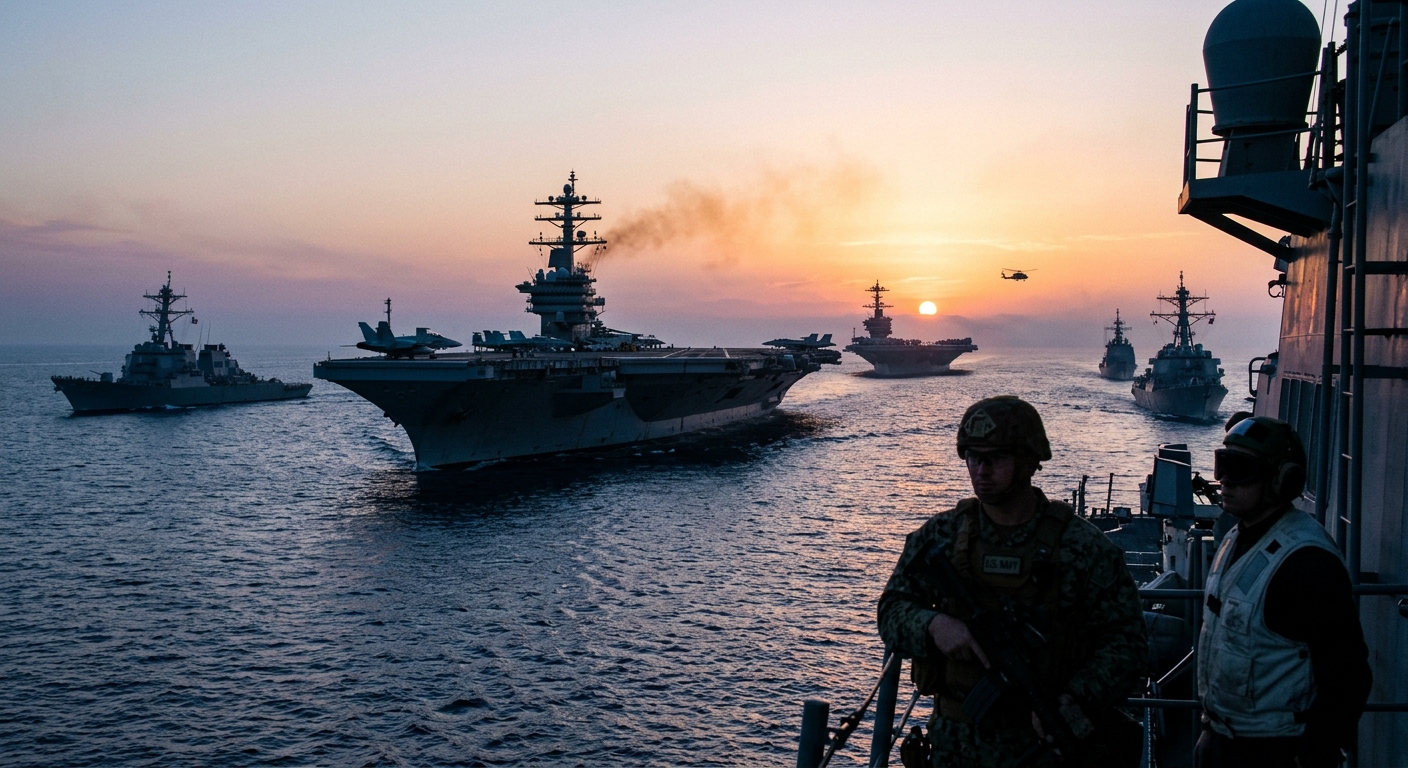
The US military has re-established a two-aircraft carrier presence in the Middle East for Iran war operations, following the departure of the USS George Washington and the arrival of the USS Theodore Roosevelt, joining the USS George H.W. Bush. This move reinforces the blockade on Iran, despite mixed signals from President Trump regarding further military action.
The US military has resumed its standard deployment of two aircraft carriers to support operations in the Middle East related to the Iran war. This comes after the USS George Washington, previously based in Japan, departed the region and returned to the Asia-Pacific. Its departure coincided with the arrival of the USS Theodore Roosevelt, which joined the USS George H.W. Bush, bringing the total back to two carriers after a brief period of three. These carriers, along with a significant naval flotilla including destroyers, cruisers, and a littoral combat ship, are crucial for maintaining a blockade on all merchant shipping to and from Iran. This blockade aims to cripple Tehran's economy by preventing its oil from reaching global markets. The naval presence also supports limited US strikes on Iranian targets in the Strait of Hormuz, a vital waterway. The disruptions to shipping and the war's unpopularity contributed to President Trump's Republican Party suffering losses in recent midterm elections. While Trump has sent mixed signals, warning Iran that the US military is 'locked and loaded' and monitoring its nuclear program while also declaring the war 'militarily effectively over,' a negotiated peace seems distant. The USS George Washington's deployment to the Middle East in August was prompted by reports of mental health and supply issues on another long-deployed carrier, the USS Abraham Lincoln, which had set a record for uninterrupted time at sea.