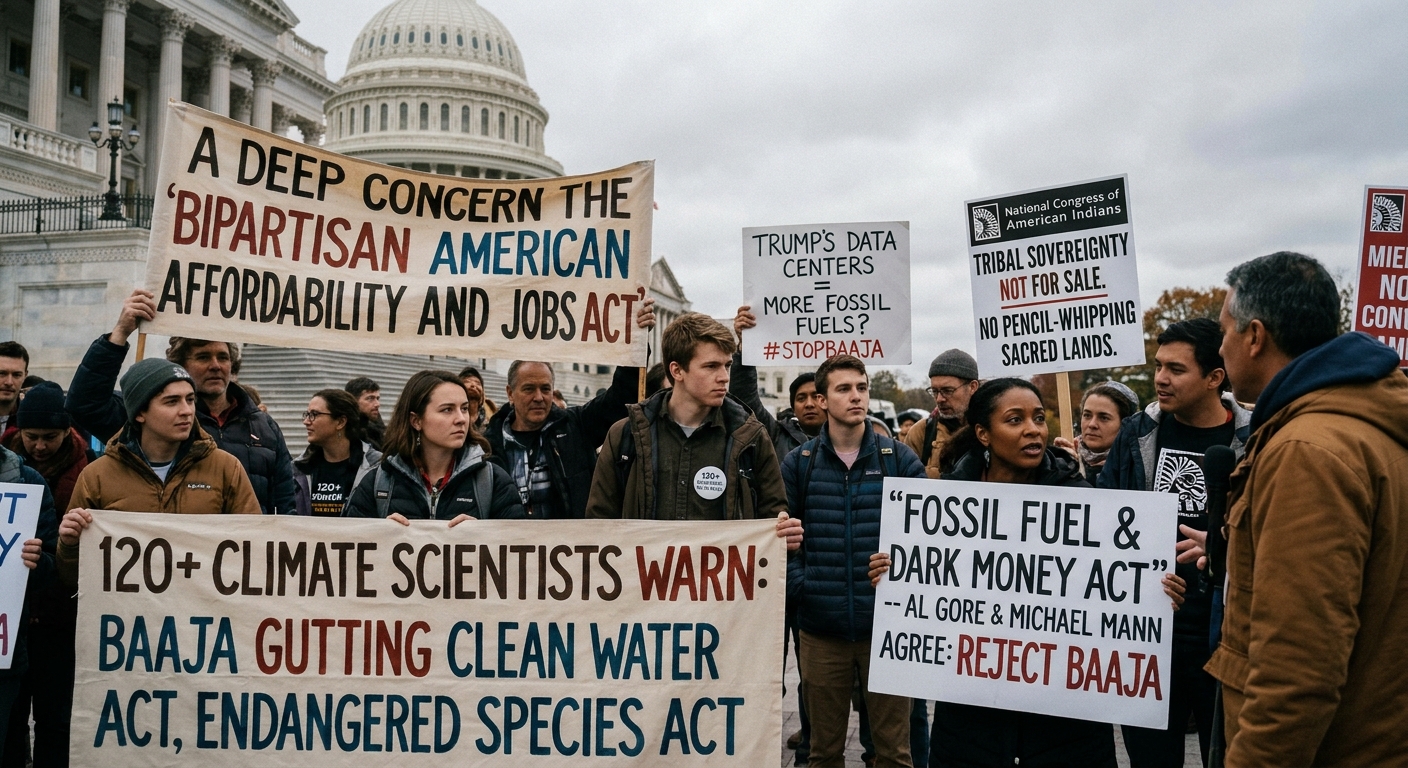
Over 120 climate scientists are urging US lawmakers to reject the 'Bipartisan American Affordability and Jobs Act' (Baaja) bill, arguing it dangerously weakens environmental laws, fast-tracks fossil fuel projects, and offers only negligible climate benefits, despite supporters claiming it will accelerate clean energy infrastructure.
A broad coalition of over 120 climate and social scientists has sent an open letter to the US House of Representatives, expressing 'deep concern' about the Bipartisan American Affordability and Jobs Act (Baaja). They contend that the bill, which recently passed the Senate, is 'deeply problematic' because it severely weakens crucial environmental protections, locks in new fossil fuel projects, and offers only minor reductions in planet-heating emissions. Critics like Michael Mann and Timmons Roberts highlight the bill's rushed passage and its potential to cause irreparable environmental damage, arguing it's backed by 'fossil fuel and dark money actors.' They warn that while the bill aims to speed up energy projects, including renewables, it also sidelines legal challenges to new oil pipelines, datacenters, and other potentially harmful infrastructure, effectively gutting core environmental legislation like the Clean Water Act and Endangered Species Act. Supporters, including Senator Sheldon Whitehouse, acknowledge the need for trade-offs, emphasizing the bill's potential for 'gigaton-scale emissions reductions,' freed-up clean power, and significant consumer electricity savings by streamlining the approval process for clean energy projects. However, opponents, including the National Congress of American Indians and former Vice-President Al Gore, are alarmed by the bill's implications for Native sovereignty, sacred lands, and the lack of community input, especially concerning a potential surge in fossil fuel activity and datacenters on public lands. They also express distrust in President Trump, who, despite supporting the bill for data centers, has vowed to block new wind power. With the bill pushed through Congress without hearings, some House Democrats are attempting to introduce amendments to address its most destructive provisions, such as ensuring tribal consultation, legal recourse for communities, and ending 'forever permit' clauses that allow destructive projects to continue indefinitely.