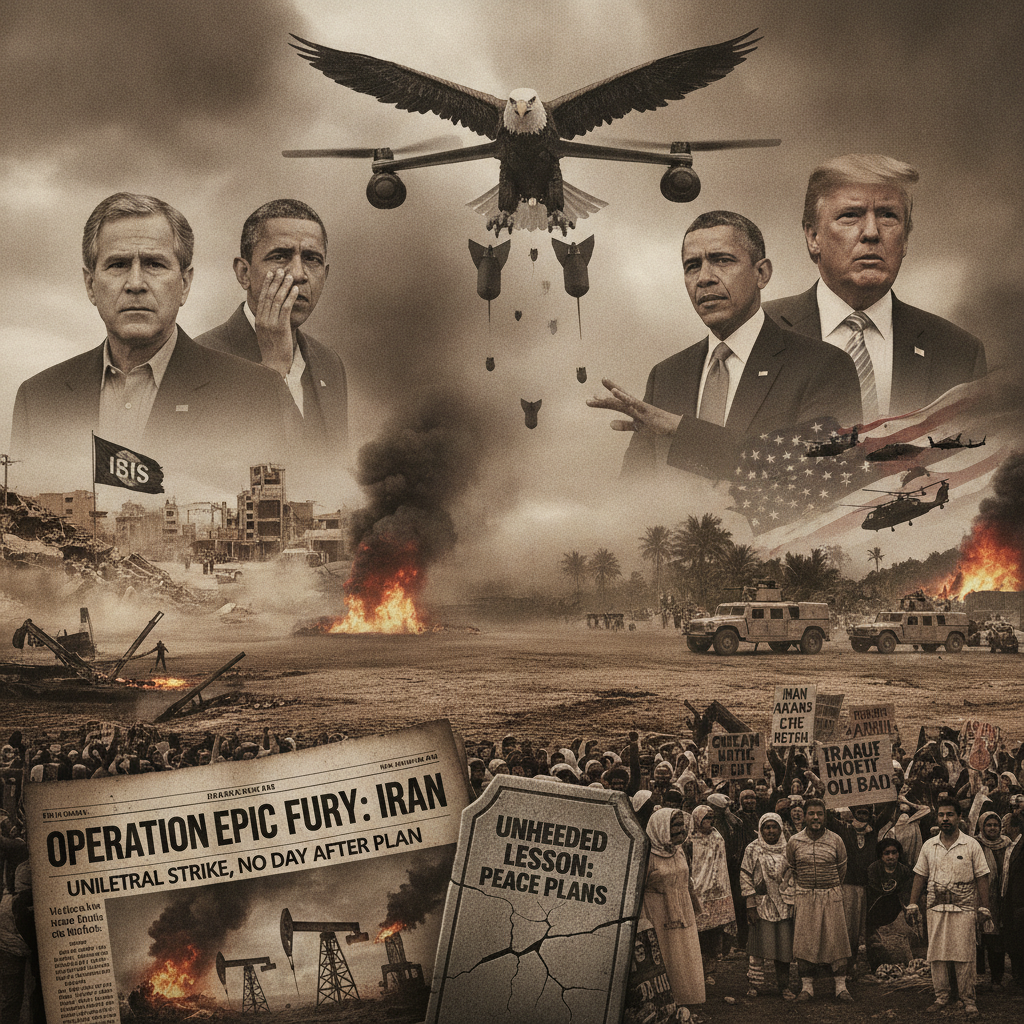
The article critically examines how US presidents, notably Donald Trump, failed to learn crucial lessons from the post-9/11 wars. It highlights the expansion of presidential war powers, the launch of conflicts like Operation Epic Fury in Iran without proper authorization or public support, and a consistent lack of 'day after' planning, which led to prolonged quagmires, civil wars, and undermined America's global standing despite tactical military successes against terrorist groups.
The article details how, 25 years after 9/11, US presidents have incrementally expanded their authority to wage war, culminating in President Donald Trump's 'Operation Epic Fury' in Iran. This conflict was initiated without congressional approval, allied backing, UN resolution, or public consensus, and crucially, lacked a post-hostilities plan, echoing past US strategic blunders. The piece traces this pattern to President George W. Bush's 'preventive war' in Iraq, which ignited a civil war and the rise of ISIS, and President Barack Obama's extensive use of drones and the intervention in Libya, where the absence of 'day after' planning resulted in a decade-long civil conflict, acknowledged by Obama as his greatest presidential failure. While US military and intelligence agencies achieved tactical successes in dismantling terrorist leadership and preventing domestic attacks following 9/11, these were overshadowed by broader strategic failures, such as the chaotic withdrawal from Afghanistan under Trump and Biden, which led to the Taliban's resurgence. Trump further broadened the 'war on terror' to include 'narcoterrorists,' exemplified by interventions in Latin America and the capture of Venezuelan President Nicolás Maduro, which emboldened his decision for the Iran war. A central unheeded lesson emphasized is the failure to formulate comprehensive peace plans after military victories, from the missed opportunity to negotiate with the Taliban in 2001 to the lack of post-regime change strategies in Iraq and Libya. The Iran war, despite military triumphs, failed to bring about meaningful regime change, instead allowing Iran to disrupt global oil markets via the Strait of Hormuz. The article concludes that the United States, once a guarantor of global stability, has become a primary disruptor due to these recurring strategic miscalculations.