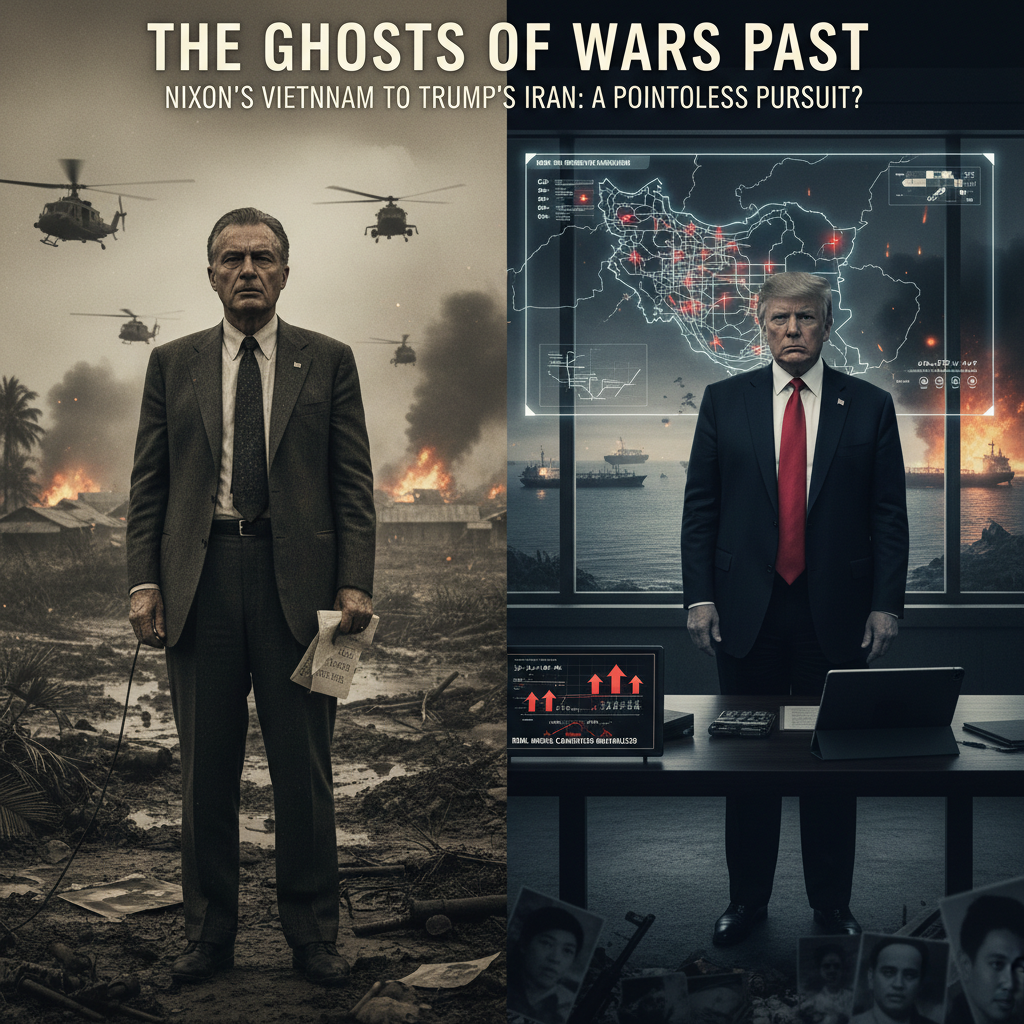
The article draws stark parallels between Donald Trump's protracted conflict with Iran and Richard Nixon's 'peace with honor' quest in Vietnam, arguing that Trump, like Nixon, is causing immense suffering for political gain without clear military objectives. It dissects Trump's shifting justifications for bombing Iran, from missile and nuclear programs to regime change and tanker blockades, concluding that Iran's negotiating power has ironically strengthened. The author suggests a de facto ceasefire as a viable de-escalation path, contrasting it with Trump's politically motivated demand for 'unconditional surrender' to save face.
Donald Trump’s struggle to justify continuing his war with Iran reminds me of Richard Nixon’s quest for “peace with honor” in Vietnam. Nixon caused years of death and suffering in pursuit of his elusive goal. How much more devastation will Trump inflict before he cuts his losses and calls off this pointless conflict? Nixon first called for “an honorable end” to the war in his acceptance speech at the 1968 Republican national convention. It became a centerpiece of his presidential campaign and his presidency. As it became clear that the South Vietnamese government could not survive US withdrawal from the war, Nixon sought to defend Washington’s credibility, cynically understood as a decent interval between America’s departure and Saigon’s collapse. To secure that two-year interval – from the Paris peace accords of January 1973 to the fall of Saigon in April 1975 – Nixon and his national security adviser, Henry Kissinger, subjected the people of Vietnam to four years of bombardment, which they extended to neighboring Cambodia and Laos. More than 20,000 American soldiers died during that period. The Vietnamese, Cambodian, and Laotian death toll was many times higher. Which brings us to Trump. Why is he continuing to bomb Iran? Not to destroy Iran’s long-range missiles. The White House says: “Iran’s ballistic missile capacity is functionally destroyed,” and its missile launch rate has declined dramatically. Not to curtail Iran’s nuclear program. That was “obliterated” last June, according to Trump, after 12 days of US and Israeli bombing. Iran is believed still to have 970 pounds of highly enriched uranium buried under nuclear sites at Isfahan and Natanz, but few think Trump would undertake the dangerous mission of putting troops on the ground to retrieve it. Not for regime change. Trump seems to have abandoned that goal. In any event, there is no precedent of ending a government from the air; even Benjamin Netanyahu admits as much. And Trump’s Maga base would go apoplectic over a ground war. double quotation markIronically, Iran is probably in a stronger negotiating position today than it was before the Trump-Netanyahu war of aggression As for the Iranian people, they are understandably reluctant to heed Trump’s call to overthrow their despicable regime, given that at least 7,000 of them were just slaughtered when they tried in January, and the US government has a poor record of backing calls to rise up against a despot, as the people of Iraq recall after they heeded George HW Bush’s appeal to overthrow Saddam Hussein. Trump’s current fixation is on Iran’s blockage of many of the tankers trying to traverse the strait of Hormuz, through which 20% of the world’s oil and gas travels. The obstruction has sent petroleum prices soaring. Trump’s latest threat is to destroy Iran’s electrical infrastructure by the end of this week unless Tehran agrees to allow the strait to reopen. Attacking Iran’s electrical infrastructure would be a war crime. The international criminal court has charged four Russian commanders for doing the exact same thing in Ukraine. Electrical power plants are civilian objects that should not be attacked, and in any case the harm to civilians would be disproportionate to any conceivable military advantage. Moreover, Iran’s assault on shipping is in retaliation for US and Israeli bombing of Iran. An obvious step in trying to stop Iran’s attacks should be to end Trump’s and Netanyahu’s bombing, now that the rationale for continuing it is increasingly tenuous. There is no guarantee that such restraint would work, but it is certainly worth trying before intensifying the war, given the global economic devastation caused by the spreading conflict, not to mention America’s dismal experiences with escalation in Vietnam, Afghanistan and Iraq. Ironically, Iran is probably in a stronger negotiating position today than it was before the Trump-Netanyahu war of aggression. Back then, Iran wanted to avoid bombardment. Now, it has suffered the worst – decapitation of its leadership, destruction of much of its military, attacks on its forces of domestic repression. The regime has much less left to lose. Of course, the Iranian people still have a lot to lose. They are suffering, but the Islamic Republic is a callous dictatorship that has never prioritized the public’s welfare over its own grasp on power. It shows no sign of relenting. Rather, the Iranian clerics have been emboldened by the success of their asymmetric military strategy. No, they cannot beat the global and regional superpowers in Washington and Tel Aviv frontally, but they can wreak havoc in the Gulf Arab states, where US military bases are located, and ravage the global economy. With the price of a tank of gasoline a major factor in the forthcoming US midterm elections, the Iranian regime may feel it has the upper hand. Trump now speaks of “very good and productive conversations” with Iran to end the conflict. Iran denies that talks are even taking place and claims that Trump is backing down because of Tehran’s own threats to attack energy sites in the region. The omens for a quick negotiated solution are not good. The Iranians are masters of delay, and they are likely to insist on at least the same things they sought during the recent nuclear negotiations that Trump, egged on by Netanyahu, aborted. They want the lifting of sanctions and an affirmation of their asserted right to nuclear enrichment. Iran’s new supreme leader has been disdainful of further negotiations. The Guardian view on Trump’s Iran ‘talks’: a war, a pause – and a distraction | Editorial Read more More fruitful deescalation could come from a de facto ceasefire. Trump should just stop bombing and compel Netanyahu to do the same. We don’t know how the Iranian regime would react, but there is a decent chance it would respond in kind rather than bear responsibility for continuing the war. If it sees its survival as a triumph, as is likely, it might seize the opportunity. But Trump also longs to “win” the war. He has said he seeks “unconditional surrender”. He wants the Iranian regime to “cry uncle”. These are political, not military, goals. They are Trump’s effort to protect himself rather than anyone in the Middle East. That is why Trump brings Nixon to mind. The “honor” that Nixon pursued was not the American people’s. Most wanted out of Vietnam the way that most today want nothing to do with the Trump-Netanyahu war in Iran. The honor that Nixon sought was his own. He didn’t want to pay the political price of having “lost” Vietnam. Similarly Trump, having embarked on this war of choice without anything approaching a valid reason, needs a face-saving way out. But how many Iranians must die, how much devastation must this senseless war cause, how much impoverishment and economic suffering must the world endure, just so Trump can declare victory? Trump is notorious for his contrafactual declarations of success. Now would be a good time for a reprise. Kenneth Roth is a Guardian US columnist, visiting professor at Princeton’s School of Public and International Affairs, and former executive director of Human Rights Watch. He is the author of Righting Wrongs: Three Decades on the Front Lines Battling Abusive Governments