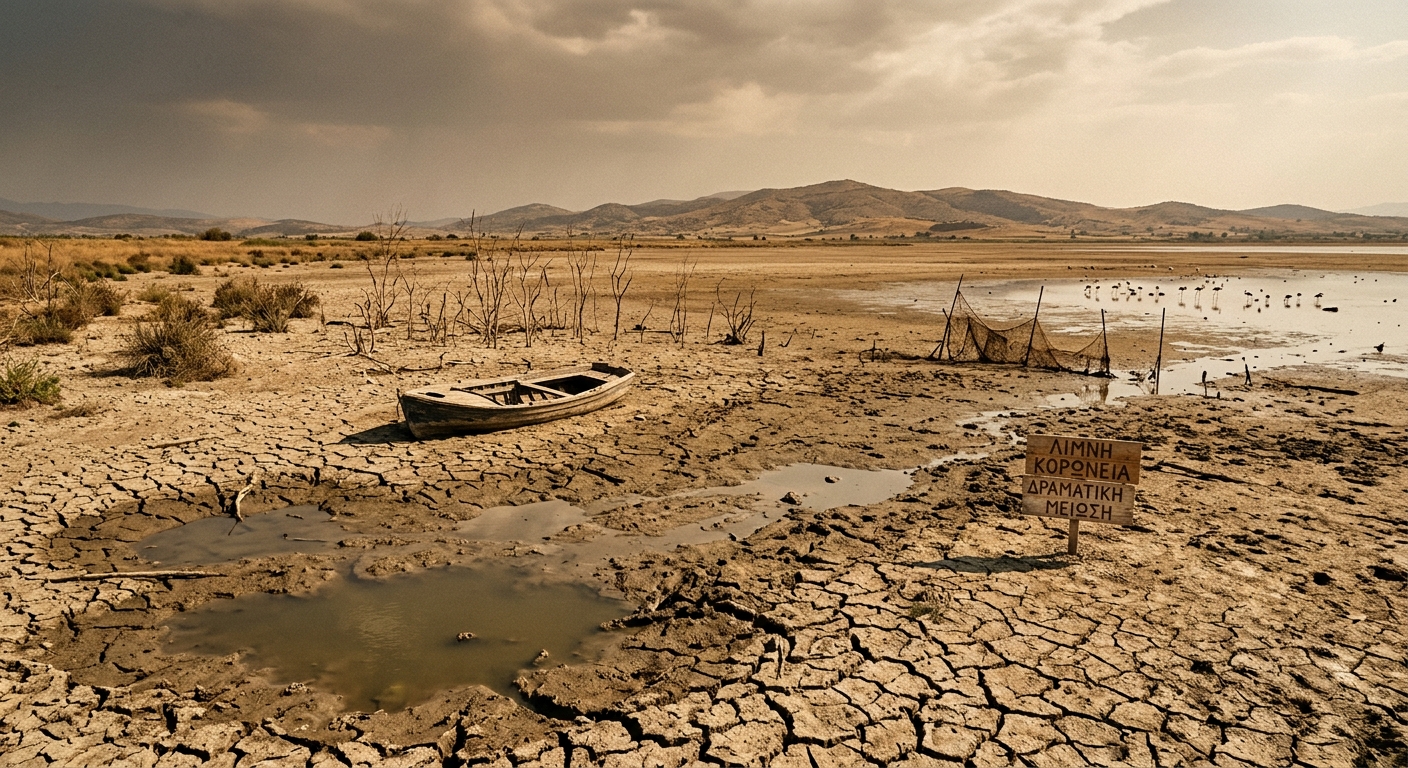
Greece's Koroneia Lake, once the fifth-largest, has drastically shrunk to less than a tenth of its original size due to a decade of low rainfall, increased evaporation, and over-irrigation, transforming a vibrant wetland into a cracked mud plain.
Koroneia Lake in northern Greece, formerly the country's fifth-largest lake, has experienced a dramatic reduction in size, now less than a tenth of its original surface area. Data from the National Observatory of Athens reveals its surface has dwindled from 34.4 square kilometres in 2016 to just 2.7 square kilometres. This alarming decline is attributed to a combination of factors over the past decade: consistently low rainfall, rising average temperatures leading to increased evaporation, and excessive irrigation by local farmers desperate to water their crops and cattle. Once a thriving protected wetland, a vital refuge for thousands of migratory and water birds like flamingos, and a popular spot for tourists, fishermen, and farmers, the lake has transformed into a vast, sun-baked mud plain dotted with murky ponds. This environmental crisis has become a stark symbol of how climate change and prolonged drought are severely impacting northern Greece, where rainfall patterns have become increasingly erratic. Scientists pinpoint the decline starting after a rainy 2015-2016 season, noting that annual rainfall in its catchment has averaged only about 400 millimetres in the last five years, significantly less than the 550 millimetres of previous decades. Concurrently, local temperatures have climbed, boosting evaporation by 100 to 150 millimetres annually. Despite a 2013 European Union court ruling that Greece failed to protect Koroneia from over-irrigation, illegal water drilling, and pollution, and subsequent government efforts to increase monitoring and reduce irrigation, the lake continues to shrink, highlighting the urgent need for more effective water management and climate adaptation strategies.