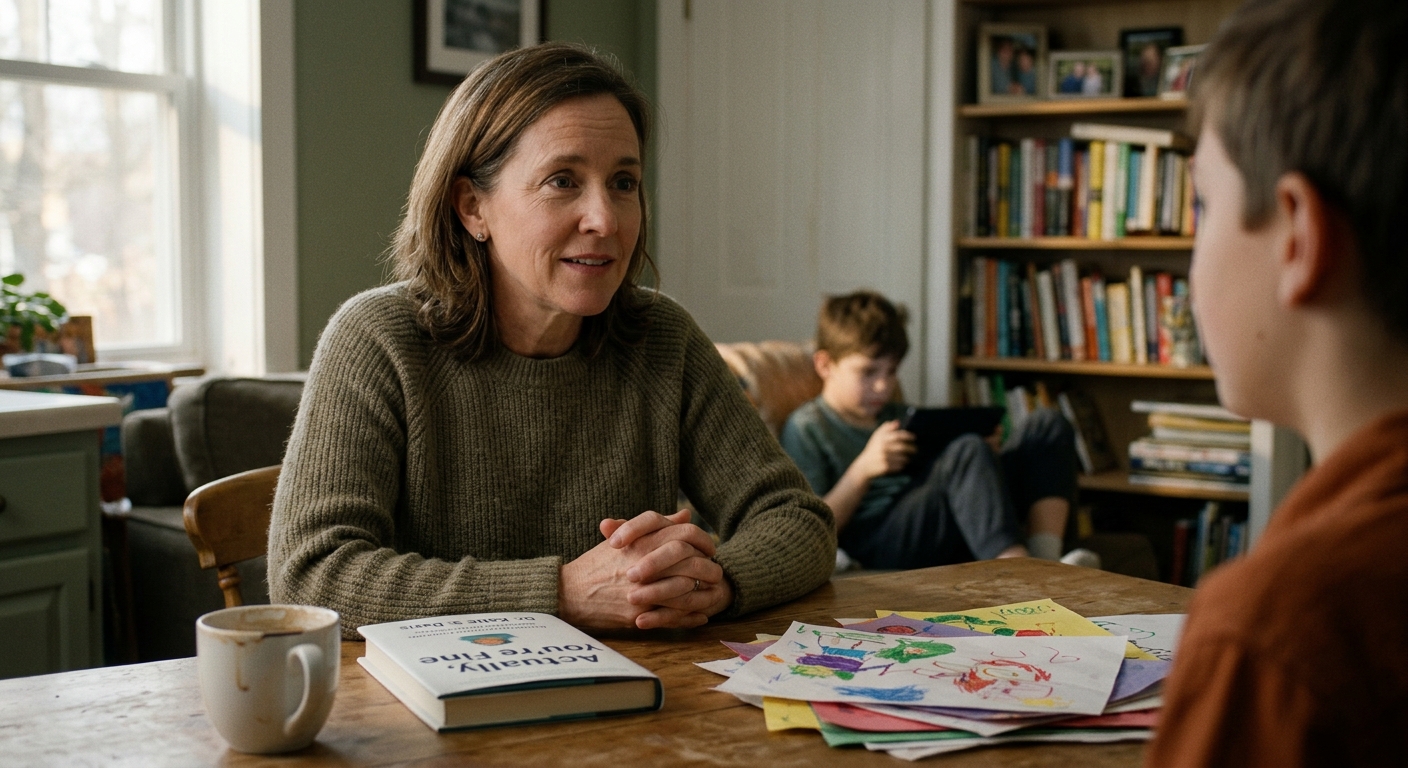
Parents' innate drive to 'fix' everything for their children, combined with societal pressures and an increase in diagnoses for even mild behaviors, can backfire. Clinical neuropsychologist Katie S. Davis explains how this over-optimization can dilute resources for truly struggling kids, negatively impact a child's self-concept, and lead to unnecessary interventions, urging parents to embrace that 'fine is fine.'
The article explores the inherent parental instinct to clear roadblocks for children, an impulse that, while once crucial for survival, now often leads to over-optimization in an age of relative safety. This drive is exacerbated by an abundance of 'expert' advice and a cultural shift where 'less-than-perfect' children are viewed as 'projects.' Clinical neuropsychologist Katie S. Davis, author of 'Actually, You’re Fine,' discusses the alarming rise in diagnoses for conditions like learning disorders, ADHD, and autism spectrum disorder. While acknowledging the benefits of diagnoses for access to services and validation, Davis raises concerns about 'concept creep'—medicalizing normal behaviors, especially in mild cases—which can spread resources too thin for those with genuine needs. Davis highlights several harms of unnecessary diagnoses: they can convey a 'something's wrong with you' message to a child, impacting their self-concept and sense of control; they can dilute resources, making it harder for truly disabled children to get the support they need; and they incur opportunity costs, diverting time and money from other enriching activities. The article also touches on the intense pressure parents, particularly mothers, face, and the importance of allowing children to face consequences and learn from them, reminding readers that development is often resilient and most people end up 'fine.' The roots of this pathologizing trend are attributed to an obsession with the brain and biologically determined behavior, a distrust of 'softer' sciences like psychology, and a pervasive parenting culture where 'fine is no longer fine.' This culture, fueled by the 'college rat race,' social media, and conflicting advice from parenting experts, fosters insecurity and the relentless pursuit of an 'excellent' child. Davis advocates for an increased ability to hold contradictions and accept uncertainty, suggesting that sometimes, waiting to see if a child grows out of a minor issue is a perfectly valid approach.