Director Gus Van Sant discusses his new film, 'Dead Man's Wire,' which dramatizes the 1977 Tony Kiritsis hostage crisis. The film, starring Bill Skarsgård and Al Pacino, explores themes of justice, media, and public perception, drawing unexpected parallels to recent events like the Brian Thompson killing and highlighting generational divides in reactions to vigilante justice.
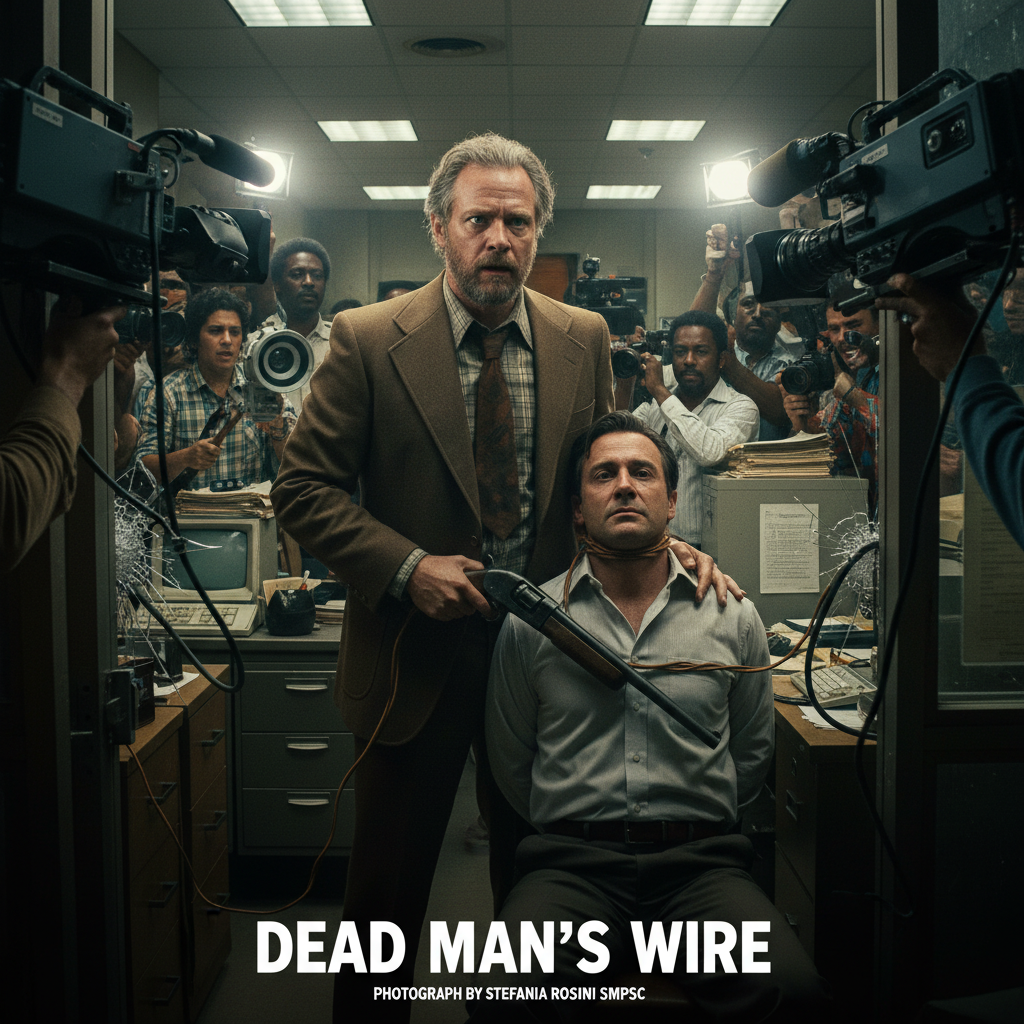
In February 1977, a middle-aged Indianapolis businessman named Tony Kiritsis took hostage an employee at his local mortgage brokers, who he was convinced had cheated him out of the profits of a piece of real estate. The system was weighted against the little guy, Kiritsis decided, and he was going to be the one to make it pay. He attached one end of a wire to the trigger of a shotgun, the other to the hostage’s head, and demanded $5m and an admission of guilt from the brokers’ boss. The final moments of the standoff, which lasted 63 hours, were broadcast live on TV. It has already been the subject of a 2018 documentary (Dead Man’s Line) and a 2022 thriller podcast (American Hostage) which starred Jon Hamm as the DJ who broadcast an interview with Kiritsis live from the crime scene. Now Gus Van Sant, whose 40-year-plus career incorporates queer landmarks (My Own Private Idaho, Milk), mainstream crowdpleasers (Good Will Hunting) and arthouse award-winners (the Columbine-inspired Elephant), is dramatising the events in Dead Man’s Wire. This wry thriller cuts between the volatile captor (Bill Skarsgård) and the media circus swirling around him, which includes the DJ, played here by Colman Domingo, and a female TV journalist (Myha’la) fed up with being fobbed off. Al Pacino has a cameo as the boss of the mortgage company, sunning himself in Malibu and unconvinced he has anything much to apologise for. Dead Man’s Wire. Photograph: Stefania Rosini SMPSP/Stefania Rosini/Row K Entertainment The film-maker was oblivious to the case at the time. “I didn’t have a TV or a newspaper subscription,” he explains by video call. He was fresh out of the Rhode Island School of Design, where three-quarters of the band Talking Heads had been in the year above him. Already a budding director, he had spent some time in Europe, including a visit to Viterbo, central Italy, in July 1975 to meet Pier Paolo Pasolini, who was editing his scandalous film Salò, or the 120 Days of Sodom. It would become Pasolini’s final film, as he was murdered four months later. “I was there with other students and he asked us what ideas we had,” Van Sant says. “My answer got kind of lost in translation. I said I thought literature could effortlessly show thoughts and ideas travelling through time whereas cinema was just figures talking. I said I wanted to transfer what literature could do into film.” Pasolini’s response? “He said he thought that was pointless,” he laughs. ‘I was trying to effect a change in cinematic vocabulary’ … Gus Van Sant. Photograph: Gareth Cattermole/Getty Images for IMDb Van Sant, who was born in Louisville, Kentucky, was living in Los Angeles by the time Kiritsis executed his plan. And it is LA that the 73-year-old maverick film-maker is speaking from today. Swaddled inside a rust-red puffer jacket, he sits on his porch facing the mountains and the blemish-less blue sky, which are reflected in the patio door behind him. His hair is grey and worn in a boyish smudge across his brow. He speaks in an amused monotone. At one point, he excuses himself to greet the refrigerator repair guy, leaving me staring at the garden furniture for five long minutes. It is not unlike watching a protracted take from one of his artier films – Last Days, say, his dreamy 2005 reflection on the demise of a Kurt Cobain-esque rock star, which was adapted into an unlikely opera four years ago. Eventually, Van Sant returns and heads inside, carrying his laptop through numerous rooms, with paintings and photographs flashing past on the walls, until he finds a new resting place. There is a lesson here: just when you think he has vanished, he always comes back. Although he recently directed most of Ryan Murphy’s gossipy TV series Feud: Capote Vs the Swans, which starred Tom Hollander as Truman Capote, it has been seven years since his last movie and almost two decades since Milk. That Oscar-winning 2008 biopic, with Sean Penn as the assassinated gay politician Harvey Milk, was the last Van Sant film anyone cared about. Until now. It’s easy to see why he was offered Dead Man’s Wire. After all, he captured acutely the flavour of the 1970s in Drugstore Cowboy, with Matt Dillon as a jittery, superstitious junkie, and identified the intersection of crime and media in the black comedy To Die For, which starred Nicole Kidman as a TV weather forecaster with a bloodthirsty craving for fame. During pre-production on Dead Man’s Wire, however, external events ensured that one element would overshadow everything else about the movie. In December 2024, the UnitedHealthcare CEO Brian Thompson was shot dead in Manhattan. This summer, 27-year-old Luigi Mangione will stand trial for the killing. As soon as the news broke, with Mangione alleged to have referred to the health insurance industry as “parasitic”, Van Sant recognised the parallels between this apparent David-and-Goliath story and the one he was about to turn into a movie. “We realised it was going to influence the way people would receive the film. And it has.” Dead Man's Wire. Photograph: Stefania Rosini SMPSP/Stefania Rosini/Row K Entertainment What he saw in the response to the killing was a generational divide. “My assistant at the time, who was in his mid-20s, said he thought there should be a statue erected to Mangione in Central Park,” says Van Sant. “We started talking about the differences between how people of his age viewed it – some thinking Mangione was a hero – and what people of my generation thought, which is that it was murder.” The fandom surrounding Mangione, though, has also acquired a queer, camp edge. Radical film-maker Bruce LaBruce, a friend of Van Sant’s, has pledged to direct a “Luigi Mangione sex cult movie”, while Luigi: The Musical will open on stage in New York to coincide with the trial. How much of the brouhaha can be attributed to Mangione’s smouldering pin-up looks, which could have earned him the lead in a Pasolini film? “For sure,” says Van Sant. “He’s very model-esque. If he looked different, there probably wouldn’t have been as sensational a reaction. He still carries that with him; he has a fan club.” Sex appeal seems to have played its part, too, in the casting of Dead Man’s Wire. Documentary footage at the end of the movie reveals the real Tony Kiritsis to have been a middle-aged schlub and very much no oil painting. Whereas the actor playing him is not only a decade younger but, as one of the Skarsgård brothers, part of a whole gallery of oil paintings. Dead Man's Wire. Photograph: Stefania Rosini SMPSP/Stefania Rosini/Row K Entertainment Weren’t there any older, uglier alternatives? “Oh, we had plenty of old, ugly guys,” he says. “But I thought Bill would work well. Though of course, he’s tall, and the real Tony had small-man syndrome. Bill told me when he was younger, he was a short kid and then he grew fast. So I guess, uh…” As his answer dissolves into amiable waffling, I’m reminded of what actors have told me about working with him. Casey Affleck, who starred in To Die For, Good Will Hunting and the desert odyssey Gerry, called the film-maker “a mystery” and “a tough nut to crack”. James Franco, who played Penn’s lover in Milk, said Van Sant “seems like he’s doing so little – you feel like you’re not being directed at all”. There is an innate calmness and patience that makes him an ideal interpreter of sensitive or inflammatory subjects, from Columbine to Cobain. Had Pasolini lived to see Van Sant’s movies, he would surely have been more amenable to his proposal when they met. Did the ideas he tried to explain to the Italian maestro in 1975 end up informing his career after all? “I think so, yeah. I was trying to effect this change in cinematic vocabulary.” Dead Man's Wire. Photograph: Stefania Rosini SMPSP/Stefania Rosini/Row K Entertainment He didn’t make much progress, he insists, until he fell under the spell of Béla Tarr. The Hungarian auteur, who died earlier this year, was thanked in the credits of Gerry, the 2002 film that kickstarted Van Sant’s most experimental phase. “I thought, ‘Oh, he’s actually done what I hoped to do.’ I always wanted to play with the way films were cut. Rules about continuity bothered me. Now everyone is filming their own stuff and posting it online, and they don’t know or care about those rules. But Béla changed things by simply not cutting. The shots went on and on.” Interviews, though, do not. As a publicist flags that our time is up, the director blinks back at me, still chunky in his puffer jacket even after half an hour indoors. For all that his films traffic in alienation, lassitude and discord, he looks the picture of serene level-headedness – a regular Gus Van Sanity. Dead Man’s Wire is in UK cinemas from 20 March