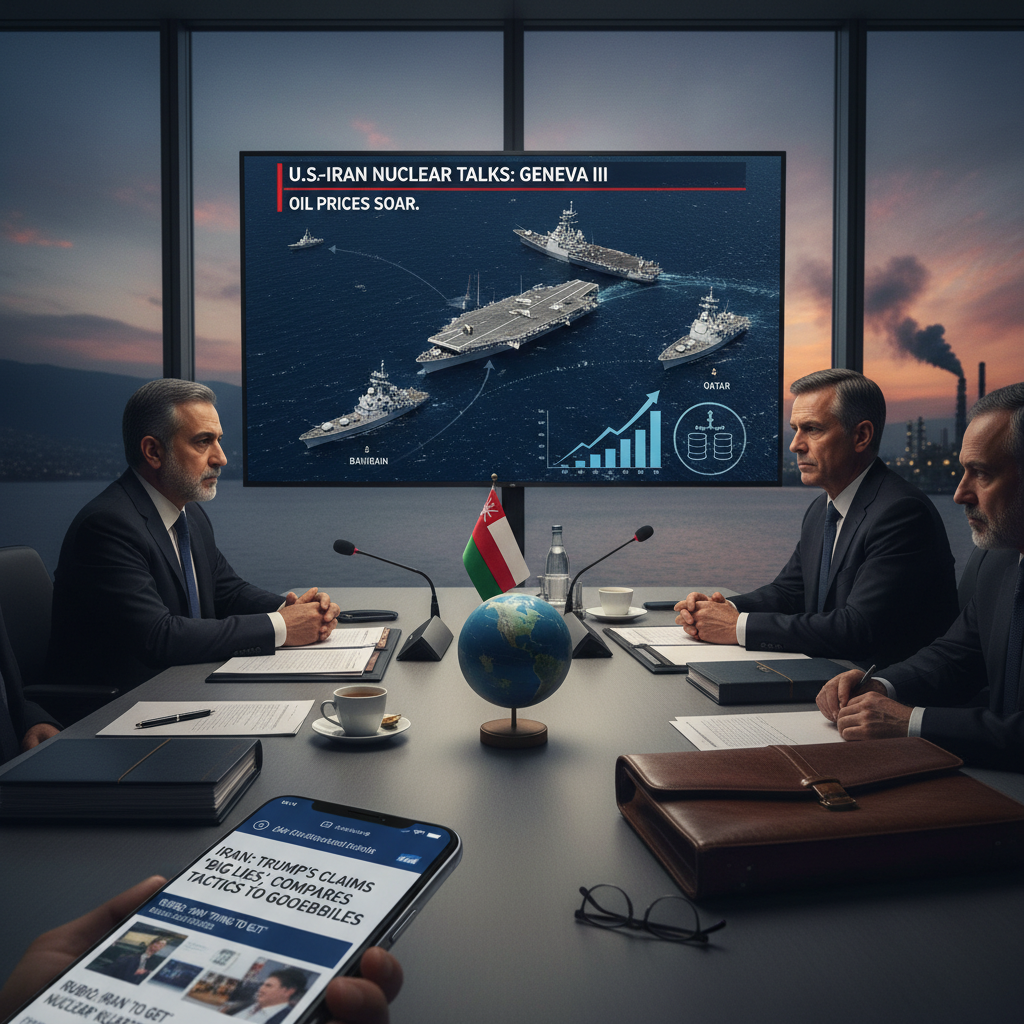
Iran vehemently rejected President Trump's accusations of rebuilding its nuclear program and missile capabilities as 'big lies' ahead of crucial nuclear talks in Geneva. This comes amidst a significant U.S. military deployment, with Navy vessels scattering at sea, and satellite imagery suggesting Iran's continued nuclear and missile activities, raising fears of potential military conflict.
Ahead of critical nuclear talks in Geneva, Iran pushed back strongly against U.S. President Donald Trump's accusations, calling his remarks 'big lies' and comparing his administration's tactics to those of Joseph Goebbels. Iranian Foreign Ministry spokesman Esmail Baghaei accused the U.S. of a 'disinformation & misinformation campaign' regarding its nuclear program, ballistic missiles, and casualty figures from recent protests. Simultaneously, satellite photos revealed U.S. Navy vessels, typically docked in Bahrain, scattering at sea, a move previously seen before Iran's attack on Qatar in June, indicating a heightened state of alert. Trump, in his State of the Union speech, claimed Iran was developing missiles threatening Europe and the U.S. and rebuilding its weapons program, including nuclear capabilities. However, Iran maintains its nuclear program is peaceful. Secretary of State Marco Rubio acknowledged Iran is not currently enriching uranium to weapons-grade levels but is 'trying to get to the point where they ultimately can.' Satellite analysis by the AP earlier showed Iran beginning to rebuild missile-production sites and working at three nuclear sites previously attacked by the U.S. in June. Iran's parliament speaker, Mohammad Bagher Qalibaf, offered a dual message: openness to 'honorable diplomacy' if mutual interests are respected, but a stern warning of a 'firm blow' if the U.S. resorts to 'deception, lies, flawed analysis and false information' and launches an attack. The third round of U.S.-Iran talks, mediated by Oman, is set to occur in Geneva with Iranian Foreign Minister Abbas Araghchi meeting U.S. Mideast envoy Steve Witkoff. Rubio stated the talks would focus on Iran's nuclear program to gauge its seriousness in reaching a deal to avert U.S. military action, though he expressed skepticism about a breakthrough given Iran's refusal to discuss ballistic missiles. Uncertainty remains regarding the outcome of these talks, the timing and efficacy of any potential military action, its regional implications, and the true status of Iran's nuclear program, which the IAEA has not been allowed to fully inspect since the June attacks. Oil prices have already risen due to these escalating concerns.