A new poll suggests Israeli Prime Minister Benjamin Netanyahu's far-right coalition is unlikely to survive the upcoming October 27 election. Three potential scenarios are outlined, indicating a complex political landscape where neither major bloc may secure a clear majority, potentially leading to a unity government, reliance on Arab parties, or even another election.
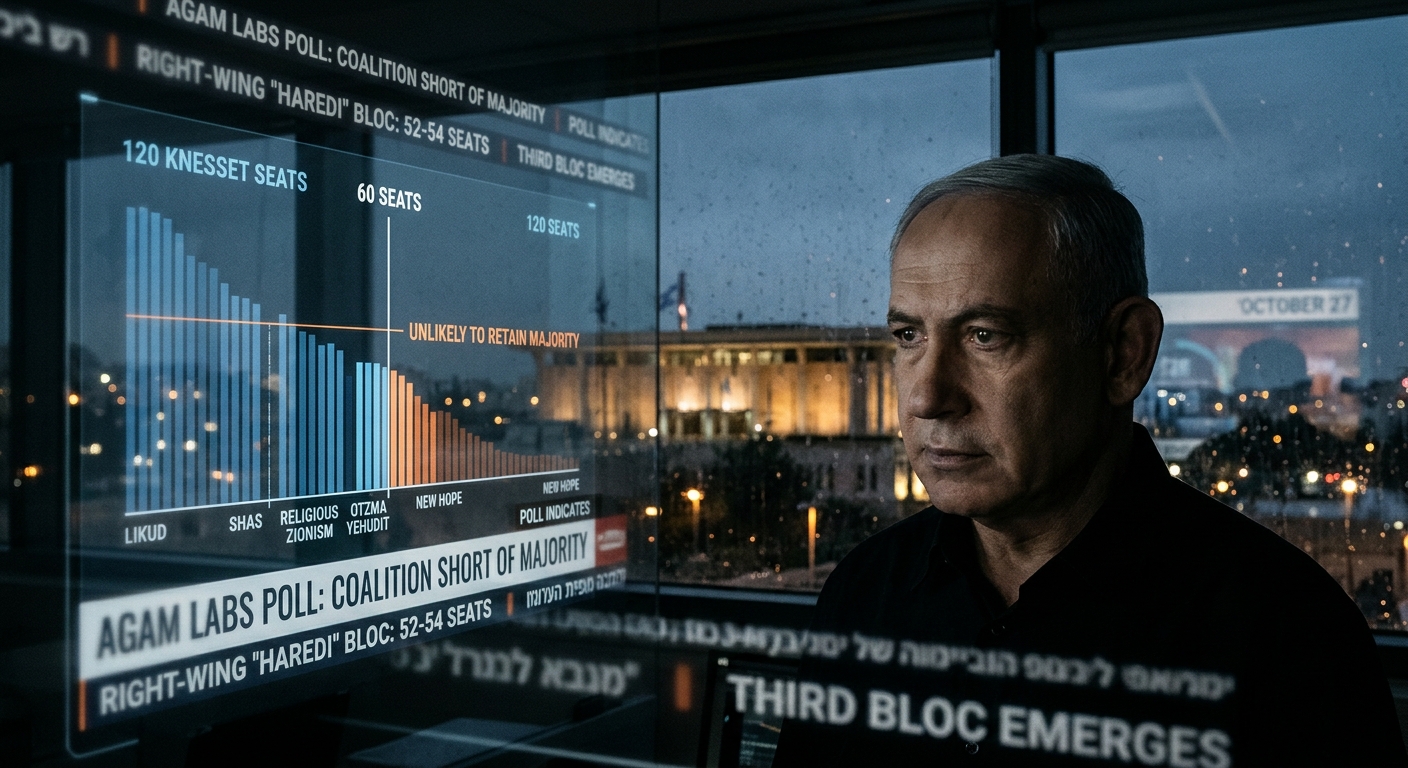
Israel is gearing up for a crucial election on October 27, where voters will use proportional representation to fill 120 Knesset seats. A new poll by Agam Labs and Hebrew University indicates that Prime Minister Benjamin Netanyahu's far-right coalition is unlikely to retain its majority. Currently, Netanyahu's government holds 60 seats (Likud 32, Shas 11, Religious Zionism 7, Otzma Yehudt 6, New Hope 4). The poll, based on 4,000 participants, projects three main scenarios. The most likely scenario sees Netanyahu's right-wing 'Haredi' bloc (including Likud and Shas, projected to drop to 19 and 6 seats respectively, plus new party Amcha) securing only 52-54 seats, far short of a majority. The opposition, led by Yashar’s Gadi Eisenkot (projected 20 seats), would also fall short collectively. This could force Netanyahu's bloc to seek support from a 'third bloc' like The Reservists and Economic Party. A second scenario involves only one 'third bloc' party clearing the threshold, increasing the influence of Arab parties (despite opposition pledges to distance themselves) as potential kingmakers for either the right-wing or liberal blocs. The third scenario, if both Amcha Israel and The Reservists fail to meet the 3.25% threshold, projects the right-wing group with 51-54 seats, the liberal group with 50-54, and Arab parties with 15-18 seats. This lack of a clear majority could trigger another election cycle, reminiscent of 2019-2022 when Israel held five elections. Experts like Dr. Nimrod Nir and Prof. Andreas Böhm suggest that while Netanyahu's current coalition is unlikely to survive, his opponents lack a clear path to power, potentially leading to a unity government, an alternative coalition backed by Arab parties, or continued political instability and further elections. Netanyahu, described as a 'master of political horse-trading,' could benefit from remaining in a caretaker role during such prolonged uncertainty. Israeli law prohibits the publishing of election polls after Friday.