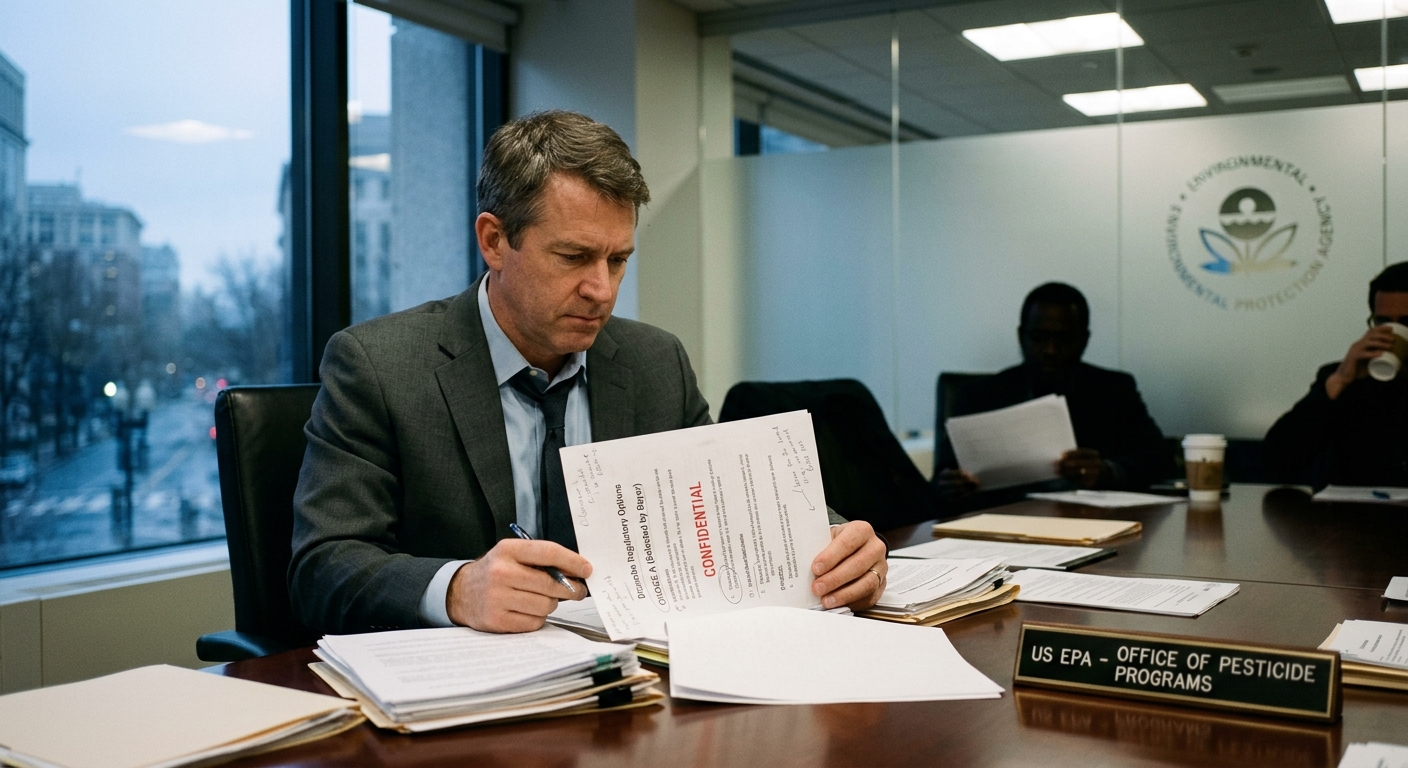
Internal documents reveal the EPA allowed Bayer, the maker of the controversial weedkiller dicamba, to select its preferred regulatory measures, including less protective options, despite the chemical's known destructive drift and health risks.
Newly released internal documents expose how the US Environment Protection Agency (EPA) permitted pesticide giant Bayer to effectively 'order up' its own regulations for the highly controversial weedkiller dicamba. The documents, unveiled during ongoing litigation, show the EPA presenting Bayer with a menu of regulation options to limit dicamba's volatility and runoff, then asking the company to choose. Dicamba is notorious for its drift, killing crops and vegetation for miles, and has been linked to liver cancer and Non-Hodgkin lymphoma. Despite courts twice ordering it off the market due to its destructive nature—which experts deem the worst in US agriculture history—the EPA has repeatedly re-approved it. Bayer chose the least protective option for volatility mitigation, allowing applications up to 95 degrees Fahrenheit under certain conditions, and a middle-tier option for runoff. The company also successfully requested an additional, unproposed change to the rule. Critics, including Nathan Donley of the Center for Biological Diversity, described the exchange as 'crossing a line,' likening it to Bayer regulating itself. The revelations come amid criticism of the EPA's leadership for being stacked with former chemical industry executives and lobbyists. While an EPA spokesperson defended the process as the 'regulatory system working exactly as intended,' stating companies can submit mitigation ideas but don't 'dictate terms,' advocates like Kelly Ryerson condemned it as undeniable proof of the EPA being 'fully captured' by pesticide companies.