The article warns that the upcoming Supreme Court decision in Louisiana v Callais threatens the Voting Rights Act, potentially ending its ability to ensure fair electoral maps for Black voters. It argues this is part of a coordinated, decade-long effort to suppress minority votes and cement one-party rule, drawing stark parallels to the post-Reconstruction era and Jim Crow laws. The author details how the weakening of the VRA since 2013 has led to restrictive state voting laws, voter purges, centralized election control, and intimidation tactics, concluding that these actions constitute a modern 'rebuilding of Jim Crow.' The piece calls for urgent state-level action and public mobilization to protect democracy and voting rights, especially in the South.
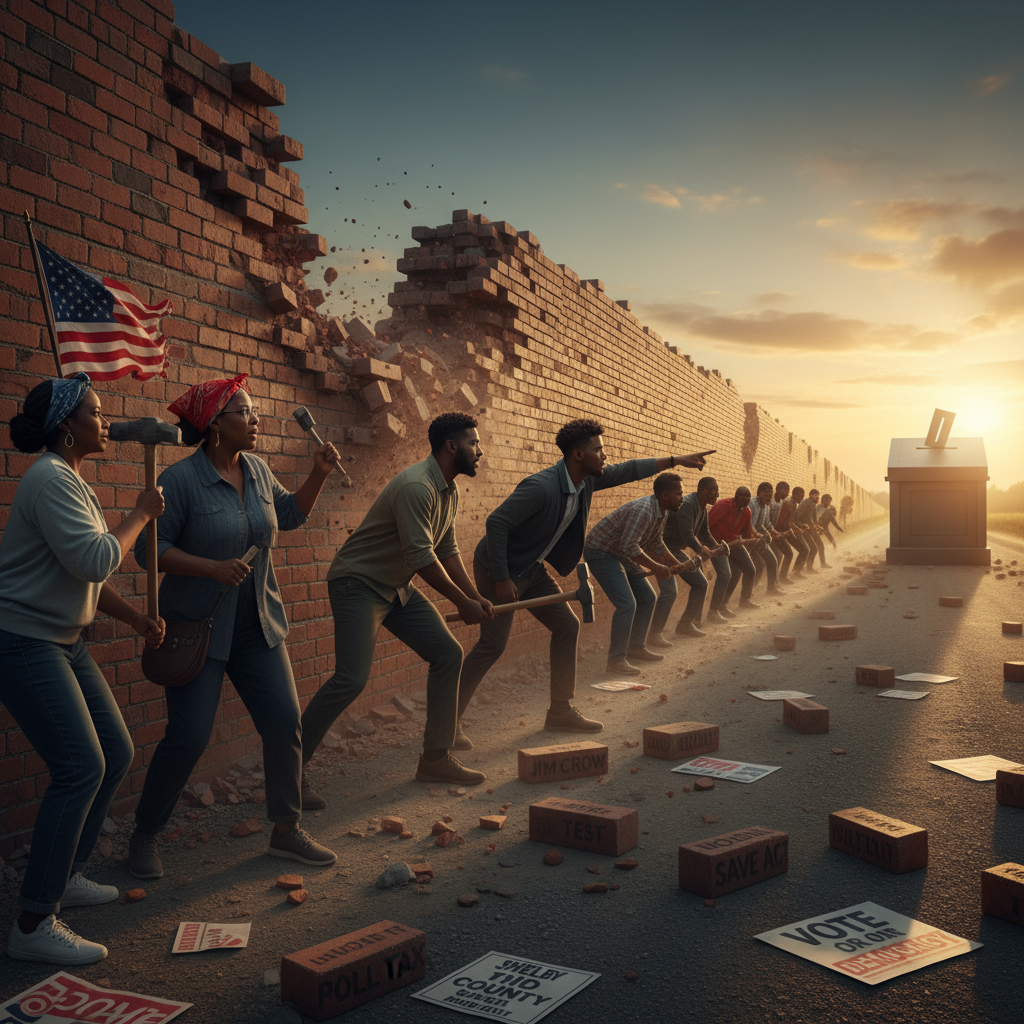
There are moments in American history when the stakes are unmistakable. This is one of them. The forthcoming decision in Louisiana v Callais will not just be another supreme court ruling in a long line of voting cases. This time the issue is whether the Voting Rights Act (VRA) can still require states to draw electoral maps that give Black voters a meaningful chance to elect representatives. The challenge to the VRA is the latest brick in a wall that has been under construction for more than a decade, a wall designed to silence Black voters and an attempt to contain, carve up and cancel out the voices of minority communities to once again cement one party rule. Let’s be honest about what is happening. After the civil war, Reconstruction cracked open the door to a multiracial democracy. Black Americans registered. Black Americans voted. Black Americans held office. For a brief moment, the promise of the 15th amendment felt real. That progress was met with terror and violence – and then Jim Crow laws that choked off political power for nearly a century. Poll taxes. Literacy tests. Legal schemes wrapped in bureaucratic language. When the Confederacy lost the war, it rebuilt its power through state law. The modern civil rights movement forced this country to confront that history. The Voting Rights Act of 1965 became the most powerful civil rights law ever enacted. It stopped discriminatory laws before they could take effect. It protected communities that had already paid too high a price for access to the ballot. And it delivered results. Black voter registration soared. Representation expanded. The south changed. That is exactly why it became a target. When the supreme court gutted the heart of the Voting Rights Act in Shelby County v Holder in 2013, it handed states with long records of discrimination a green light. It led to the closure of polling places, overwhelmingly in Black communities, and voter ID requirements tailored to the kind that African Americans did not have. The unrelenting assault intensified after African Americans overcame those barriers as well as a pandemic to flip Georgia and unseat Donald Trump. From the Shelby County decision to June 2023, 11 states with long records of voting discrimination passed 29 restrictive voting laws, many of which were based on the lies of a stolen election. After 2020, election conspiracy theorist groups flooded legislatures with fraud claims and demands for audits. National organizations such as Alec and the Heritage Foundation then helped convert those narratives into model legislation, exported from Washington and replicated in statehouses across the country. Six years later, Trump and his allies still obsess over 2020. They bring it up to create doubt. To justify intervention. To challenge results when they lose. double quotation markIt is a coordinated theory of power: centralize control, discredit local administration, purge voter rolls, and narrow who gets to participate And the pattern extends beyond state legislatures. The president has openly talked about “taking over” elections. We witnessed an unprecedented raid on local election offices in Fulton county in Georgia. The Department of Justice has sought expansive voter roll data from states. There have been reports of ICE-related intimidation tactics used to pressure compliance. This is not isolated activity. It is a coordinated theory of power: centralize control, discredit local administration, purge voter rolls and narrow who gets to participate. The so-called Save Act is a voter purge bill dressed up as security. It would force millions of eligible Americans to navigate new documentation hurdles simply to register. Women who changed their names. Seniors born at home, part of a generation of Black Americans whose births were never formally documented or issued. Naturalized citizens. Working-class voters without ready access to passports. That is not an accident. It is a design feature. The Save Act must be defeated. But it’s just one step in the fight to protect American voting | Austin Sarat Read more When you stack it all together – the erosion of the Voting Rights Act, the surge of restrictive state laws, the failure of Congress to act, the intimidation tactics, the push for voter roll data, the calls to seize control of election administration – the picture comes into focus. They are rebuilding Jim Crow in modern form. With statutes. With court opinions. With procedural barriers that fall hardest on Black communities. And it is beginning, again, in the south. That is why state-level voting rights acts matter more than ever. They are not symbolic. They are firewalls. They are attempts to reconstruct, at the state level, the protections the federal government abandoned. Because when federal guardrails disappear, the states most eager to restrict the vote move fastest. And it is accelerating. Jim Crow was a political project designed to preserve racial hierarchy through law and the power structure that depended on it. When we see coordinated efforts to purge voters, centralize election control, dismantle the Voting Rights Act and dilute Black political power, we should call it what it is. Brick by brick, they have been building a wall to keep Black and brown voters out of democracy. But American history teaches us something else: some walls are meant to be torn down. And the south is once again the testing ground for whether we pick up the hammer and strike a blow for democracy. Sixty-one years ago, on the Edmund Pettus Bridge in Selma, Americans marched and bled for the right to vote – a fight that helped deliver the Voting Rights Act. Today, we must be equally mobilized, organized and energized in our communities to register to vote and turn out in our communities to bend the moral and political arc of the universe toward justice. Dr Carol Anderson is the Charles Howard Candler professor and chair of African American Studies at Emory University and the author of White Rage: The Unspoken Truth of Our Racial Divide