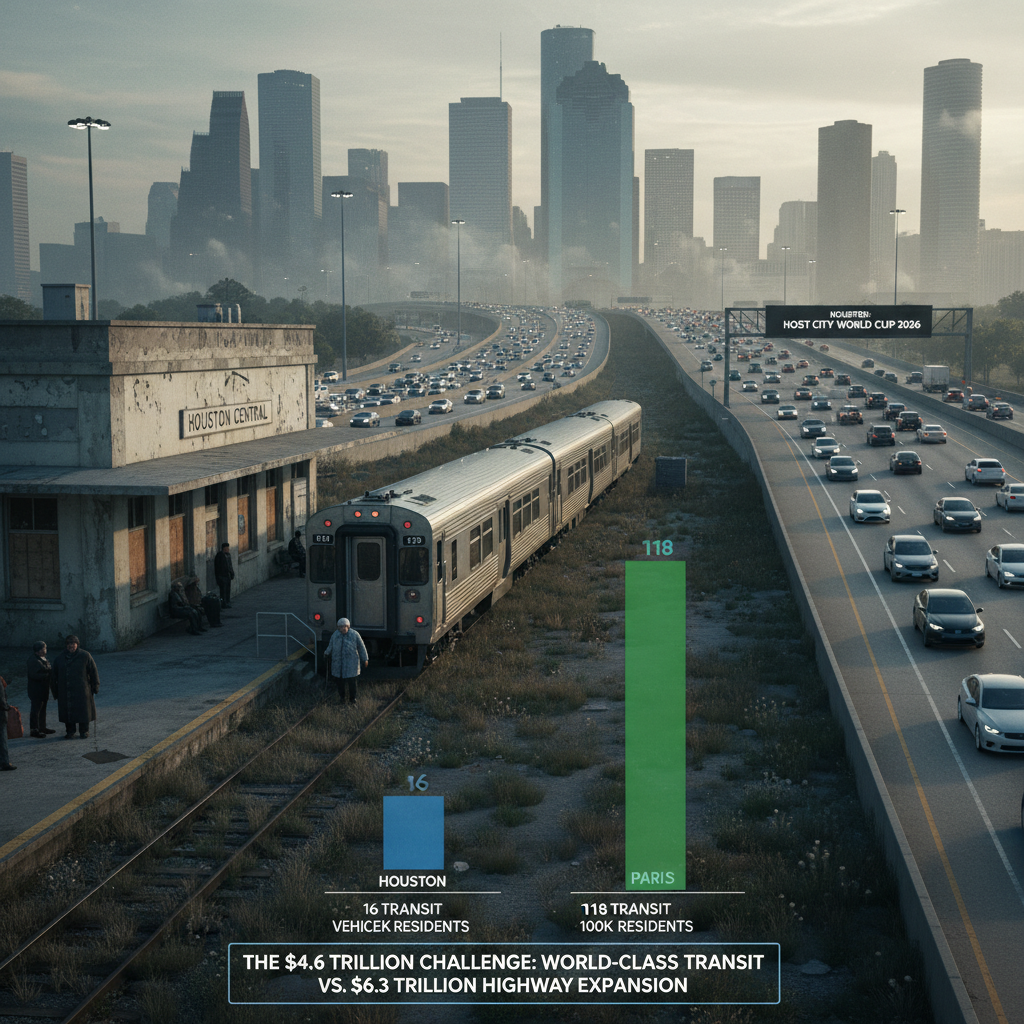
US cities, epitomized by Houston's meager train station, possess severely inadequate public transportation systems, leaving them far behind global counterparts and necessitating an estimated $4.6 trillion investment to achieve world-class transit standards.
The article highlights the dismal state of public transportation in US cities, using Houston's diminished, thrice-weekly train station as a stark symbol. US metropolitan areas, like Houston with 7 million people, rely on systems with significantly fewer transit vehicles per capita (e.g., Houston has 16 per 100,000 residents compared to Paris's 118). A recent report estimates that achieving 'world-class' transit—defined as an accessible, frequent, reliable, and convenient alternative to cars—would cost an enormous $4.6 trillion over 20 years, requiring 7,500 miles of new infrastructure. This car-centric approach has dire consequences for convenience, human health, and the environment, with transportation accounting for a third of global planet-heating emissions. While New York City's subway approaches global standards, it still lags behind cities like Tehran proportionally. The problem is exacerbated by historical decisions, including the prioritization of highway expansion (the US will spend $6.3 trillion on highways in the same period) and zoning laws that foster suburban sprawl, making public transit less viable. Experts like Kari Watkins note the political resistance to change, forcing those without cars—due to age, disability, or cost—to navigate laborious and inefficient routes, effectively making them 'second-class citizens.' Despite voter interest in better transit, post-pandemic revenue drops and political opposition (like the Trump administration's attempts to slash funding and the Houston mayor's removal of bike lanes) hinder progress. Advocates remain hopeful, pointing to events like the World Cup in Houston as opportunities to showcase the benefits of public transit, but acknowledge the monumental task ahead, with Houston needing a 435% increase in its transit fleet to match European levels.