Democratic socialist Oliver Larkin is mounting a surprisingly strong challenge against 'DeSantis Democrat' Jared Moskowitz in a crucial Florida primary, testing the viability of progressive politics in a red-leaning state and district.
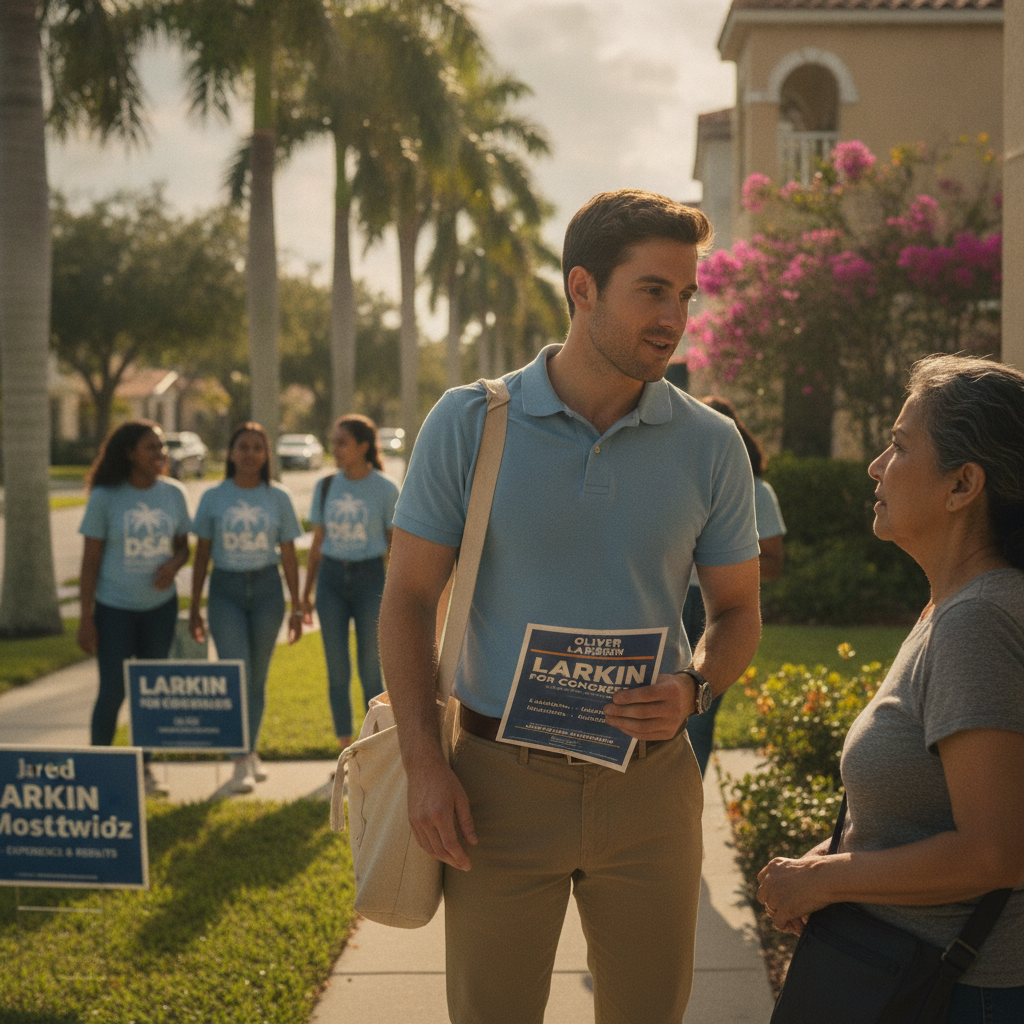
Oliver Larkin, a 34-year-old democratic socialist, is running for Congress in Florida's competitive 25th district, challenging two-term incumbent Jared Moskowitz, a self-described "DeSantis Democrat." Larkin's campaign employs extensive door-to-door canvassing, advocating for policies like universal healthcare, free public university tuition, affordable housing, and immigration reform, often without explicitly using the "socialist" label. This grassroots approach contrasts with Moskowitz's avoidance of public debates. Larkin, whose political journey began after being inspired by Bernie Sanders, criticizes Moskowitz's ties to Governor DeSantis and his votes on issues like the Laken Riley Act. Moskowitz, in turn, positions himself as a pragmatist willing to work across the aisle, highlighting his emergency management background. The race is a critical test for the Democratic Socialists of America (DSA), aiming to prove their momentum from wins in traditionally blue areas can translate to a diverse, newly drawn, and highly competitive Florida district that Donald Trump carried. Despite Moskowitz's initial financial and polling lead, Larkin has significantly narrowed the gap through grassroots fundraising and DSA support, with recent polls showing a statistical tie. Experts, however, caution against over-reliance on primary polling. The district, predominantly white with a sizable Hispanic population and older voters, presents unique challenges for a progressive candidate due to Florida's ingrained anti-socialism sentiment and history of rejecting the party's far-left flank. Critics argue Larkin's policies would be a liability in a general election. However, Larkin counters that his policies resonate with working-class voters, and Florida has a history of supporting progressive issues like voting rights and a higher minimum wage. Regardless of the primary outcome, the DSA is seen as having already achieved a victory by gaining significant attention and "planting seeds for the future of the movement" in Florida.