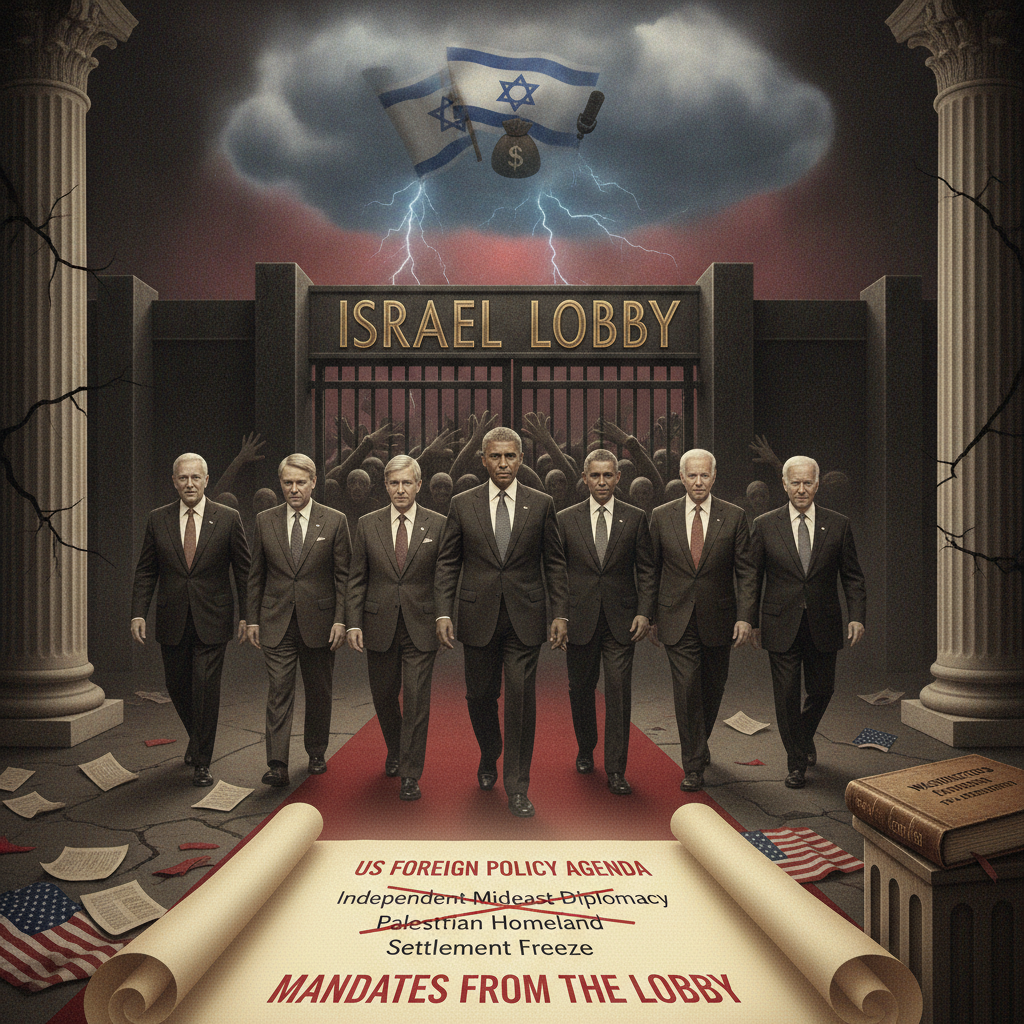
This article exposes how the Israel lobby has consistently swayed US foreign policy in the Middle East, often overriding presidential and expert advice, from Harry Truman's recognition of Israel to Joe Biden's recent actions in Gaza, shaping decisions against America's perceived national interests.
The article details how the Israel lobby has exerted profound and often decisive influence over US foreign policy in the Middle East for decades, frequently compelling presidents to act against the unanimous recommendations of their top foreign policy and national security officials. Beginning with Harry Truman in 1948, who recognized Israel despite Secretary of State George C. Marshall's strong opposition and warnings of regional war, the narrative traces a pattern of presidents succumbing to domestic political pressure from Zionist organizations and their advocates. Marshall, concerned about Soviet exploitation and the risk to oil supplies, initially convinced Truman not to recognize Israel, but Truman reversed course within two days due to election year pressures and the lobby's power. This pattern continued with President Gerald Ford, whose 'reassessment' of Middle East policy, aimed at pressing Israel for peace, was derailed by a letter from 76 senators drafted by AIPAC, leading to increased US support for Israel. President Jimmy Carter's efforts for a comprehensive Arab-Israeli peace and a Palestinian homeland were met with intense lobby opposition and 'blackmail' from Israeli officials, forcing him to scale back his ambitions to a separate peace deal between Israel and Egypt. George H.W. Bush publicly expressed frustration with the lobby's 'ferocious opposition' when he tried to condition US loan guarantees on Israeli settlement freezes. Most recently, President Barack Obama, despite entering office with a commitment to a two-state solution, reversed his stance on Israeli settlements due to a 'storm of outrage' from Israel and its lobby, fearing accusations of antisemitism. President Joe Biden, believing in a 'special relationship' with Israel, similarly ignored his advisers' recommendations to intervene meaningfully in the Israeli onslaught on Gaza, fearing political punishment. Even Donald Trump's decision to go to war on Iran is presented as another instance of yielding to Israeli pressure. The article argues that the lobby, comprised of various organizations, has exploited voter ignorance and used 'enormous resources' to 'punish or reward politicians' at all levels. It highlights how this influence has consistently led American presidents, from Truman to Trump, to abandon foreign policies believed to be in the best interests of the US, hindering progress toward a peaceful resolution of the Israeli-Palestinian conflict. While acknowledging the right of supporters to express opinions and that presidents have free will, the article concludes by echoing George Washington's warning against 'passionate attachment' to a foreign country, asserting that such unchecked influence distorts US foreign policy and endangers American interests and freedoms, despite recent shifts in public opinion against Israel and the growing number of Israel critics winning congressional primaries.