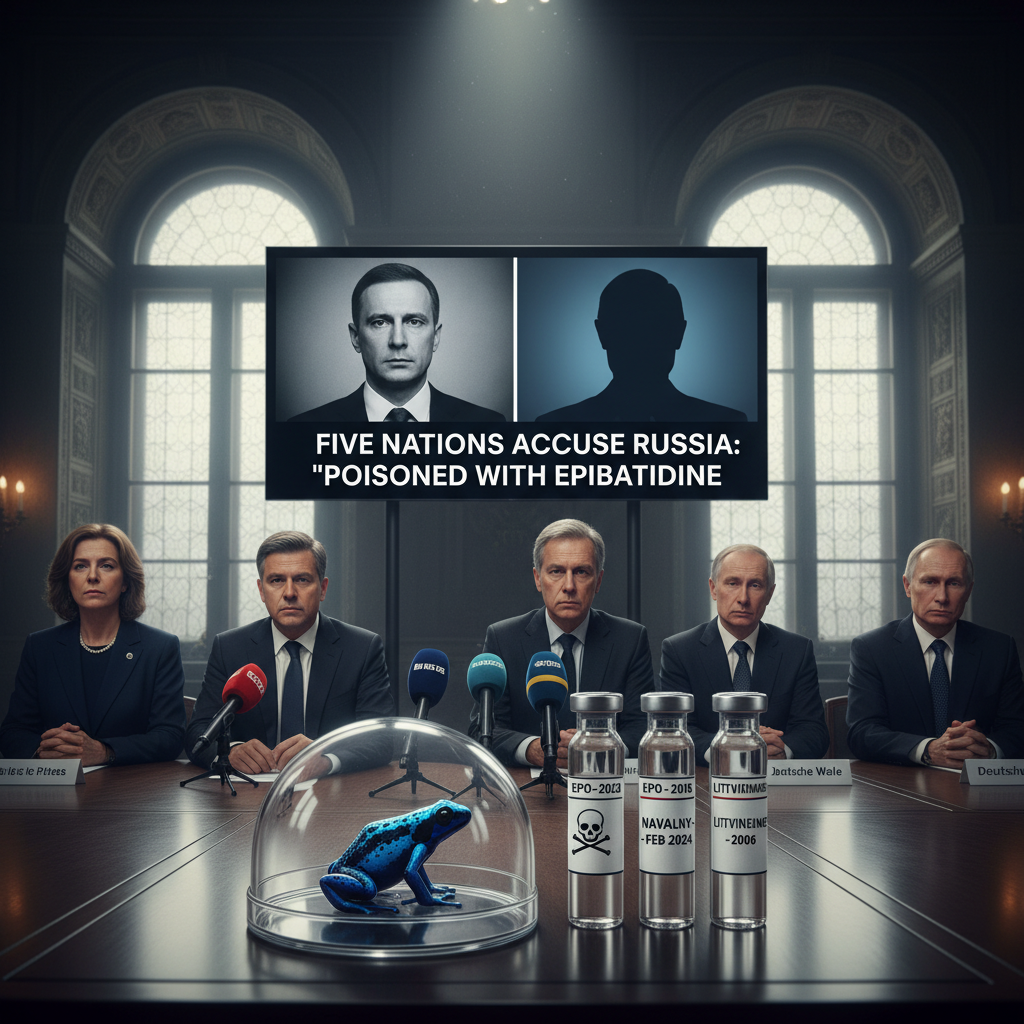
Five European nations have conclusively confirmed that Russian opposition leader Alexei Navalny was poisoned with epibatidine, a rare neurotoxin found in poison dart frogs, and are accusing the Kremlin of his death. They state Russia had the 'means, motive, and opportunity' and are reporting the country for breaching the Chemical Weapons Convention.
Five European countries—the U.K., France, Germany, Sweden, and the Netherlands—have officially announced that Russian opposition leader Alexei Navalny was poisoned with epibatidine, a rare and lethal neurotoxin found in the skin of poison dart frogs. Analysis in European labs of samples from Navalny's body 'conclusively confirmed the presence of epibatidine,' a substance not naturally found in Russia but secreted by South American dart frogs. A joint statement from the nations accused Russia, stating it 'had the means, motive and opportunity to administer this poison,' and announced they are reporting Russia to the Organization for the Prohibition of Chemical Weapons for a breach of the Chemical Weapons Convention. Navalny, a fierce critic of President Vladimir Putin, died in an Arctic penal colony on February 16, 2024, while serving a 19-year sentence. British Foreign Secretary Yvette Cooper and French Foreign Minister Jean-Noël Barrot condemned the act, with Barrot suggesting Putin is 'prepared to use biological weapons against his own people.' Navalny's widow, Yulia Navalnaya, expressed certainty that her husband was poisoned and called Putin a 'murderer' who 'must be held accountable.' Russian authorities have vehemently denied the accusations, claiming Navalny died from natural causes. Epibatidine, which can be lab-manufactured, works similarly to nerve agents, causing severe physiological distress and death. This incident follows Navalny's prior poisoning in 2020 with a nerve agent and other alleged Russian state-sponsored poisonings, including the 2018 Salisbury attack and the 2006 death of Alexander Litvinenko.