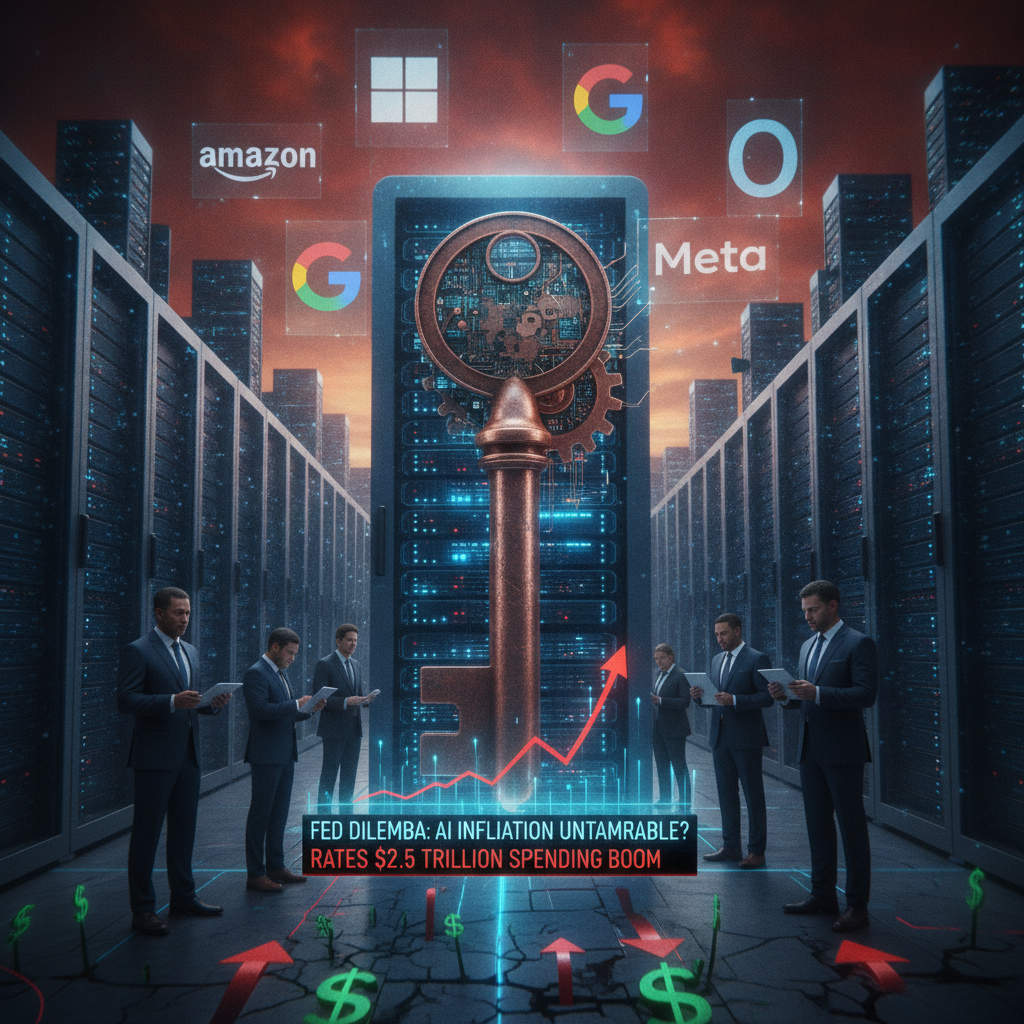
The Federal Reserve is set to raise interest rates to combat inflation, but officials are increasingly concerned that the massive, insatiable demand from the AI infrastructure boom could render traditional monetary policy ineffective, leading to prolonged price pressures.
The Federal Reserve is poised to raise interest rates for the first time since July 2023, primarily to counter inflation exacerbated by geopolitical conflicts. However, a more formidable and potentially untameable inflation threat has emerged: the colossal build-out of AI infrastructure. Officials, including New York Fed President John Williams, are worried that the huge investments in data centers are driving up aggregate demand for everything from semiconductor chips and power to skilled labor. Multibillion-dollar companies are aggressively competing for limited resources, creating a scenario where demand consistently outstrips supply, potentially leading to higher inflation for a longer period. Wall Street expects multiple rate hikes, but experts like Jim Caron of Morgan Stanley Investment Management question their efficacy, noting that tech companies are focused on capturing market share in the early stages of AI development, making them less sensitive to marginal interest rate increases. Spending on data centers is projected to reach $1.1 trillion by 2030, with overall AI-related spending exceeding $2.5 trillion this year alone. Fed officials like Beth Hammack, Neel Kashkari, and Lorie Logan have already voiced concerns, with some dissenting from previous decisions to hold rates steady. The Fed's main tool, the key interest rate, primarily affects demand, but its power is diminished when "hyperscalers" like Amazon, Microsoft, Google, Meta, and Oracle possess strong balance sheets and are driven by a strategic imperative to build the future of AI. These companies are also increasingly tapping the bond market for financing, adding further complexity. The dilemma for the Fed is that while it can raise rates to cool the broader economy, this may not significantly slow the AI spending boom and could instead negatively impact other economic sectors, such as the labor market. The ultimate question remains whether these vast investments will yield sufficient returns to justify the costs and demand.