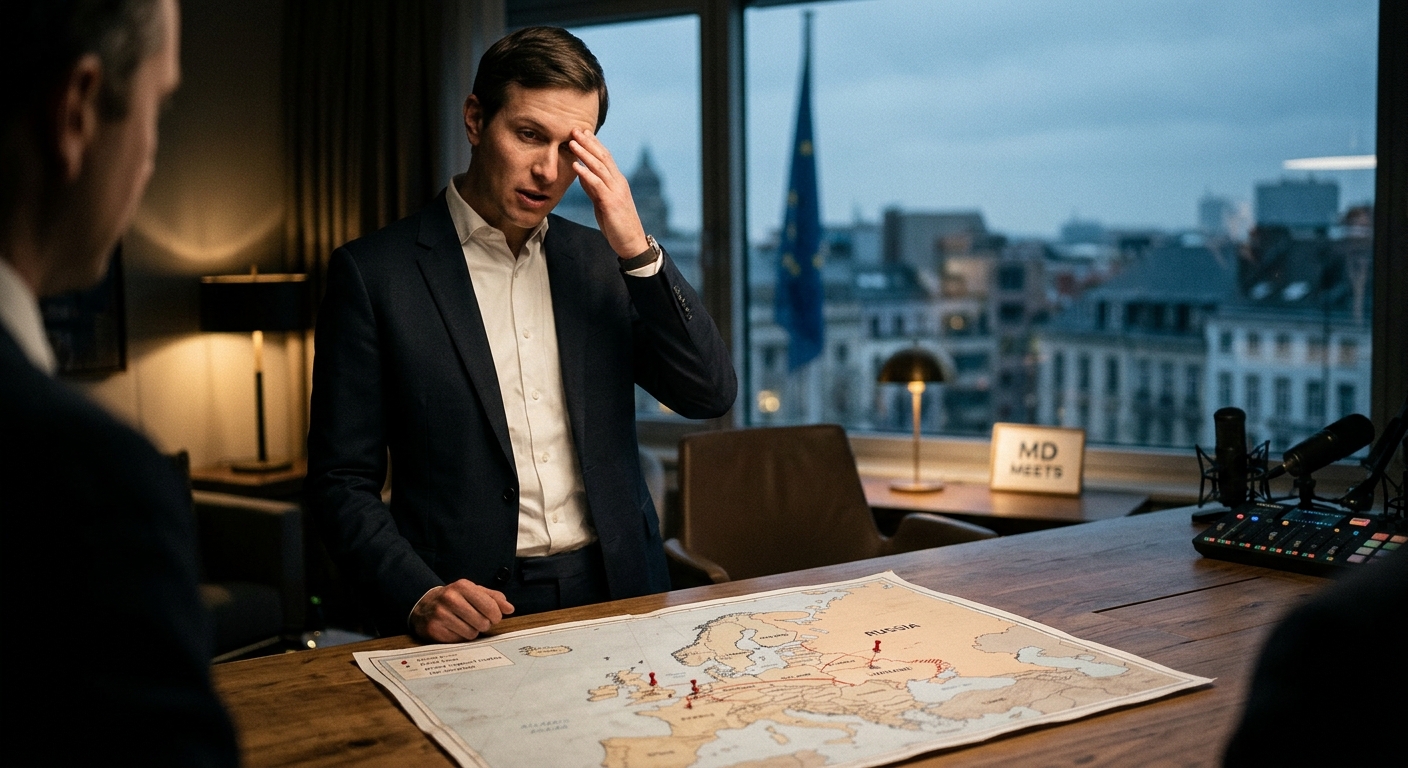
Jared Kushner, the US envoy, claims Europe lacks a peace plan in Ukraine, calling the conflict a proxy war. He suggests both the US and Kremlin view Europe as a barrier to peace and controversially praised Vladimir Putin for not using nuclear weapons. Kushner also dismissed Ukraine's NATO ambitions and highlighted potential US-Russia business deals, while the article criticizes the Trump administration's stance on aid and European security.
Europe is fighting a proxy war against Russia in Ukraine and has no plan for peace according to Jared Kushner, the US envoy brokering talks between Moscow and Kyiv. The staggering claims, which mirror and amplify the same story from Vladimir Putin, come as the US has been stepping up military pressure on Ukraine. Kushner, along with Steve Witkoff, has been leading talks with Russia and Ukraine for a year. In an interview with Matthias Dopfner of the MD Meets podcast he revealed deep friendships with some of Vladimir Putin’s envoys but mentioned only one Ukrainian, Volydymyr Zelensky, by name. He said the Russian president “has very little confidence that if he stops the war, um, that that he won't be able to get to a post-war settlement that leads to not having a future”. He went on to explain that the US and the Kremlin agreed that Europe has become a significant barrier to peace. “And I think that that's a consideration of his, and I think it's a consideration of ours as well. So we understand that,” he said. “I think in terms of these provocations, we're living in an incredibly dangerous time where this war is somewhat contained to Ukraine, but it's effectively become a proxy war where Europe is funding and arming Ukraine against Russia”. Kushner also appeared to praise Putin for not launching a nuclear attack against Ukraine. “It won't take a lot of miscalculation for this thing to escalate massively. Now so far Putin has showed restraint. He's agreed not to use nuclear weapons, which obviously is a big thing, and he's reassured us that that's not his intention,” the US envoy, who is Donald Trump’s son-in-law, told the podcast. He insisted that he welcomes the participation of European delegates in future talks but immediately undermined their standing with another attack on the democratic west, which includes Canada and other non-European allies. “What we should do is focus on the post-war, which again, I think makes sense for us because you want to get to a peace that's gonna last. So there's no reason why we can't be talking and designing and coming up with proposals, which we have been doing simultaneously, and hopefully by designing this, we'll be able to get to that ceasefire. “And I think that that's really the only way that we've seen. We've asked the Europeans or the Ukrainians if they have a better idea on how to get there, uh, but nobody's presented us with one so far”. European leaders have been clear in saying that they want to continue to support Ukraine with funding and weapons to preserve its sovereignty and democracy. They have rejected every effort by the Russians to claim a right to demand the redesign of Europe’s own security architecture. This has been driven by the US acceptance of the claim that Putin ordered the invasion of Ukraine in 2022 because of the expansion of Nato membership to eastern European countries that once fell under Soviet domination from Moscow. Putin has said many times that this was a reason for Russian paranoia. But he has also written essays and given speeches in which the reoccupation of Ukraine, which he denies is a country anyway, is an historical necessity for Moscow in a effort to restore in tsarist, or Soviet, empire. Putin has been indicted for alleged war crimes by the International Criminal Court. Kushner said like him or not, “he’s definitely a grand master of politics”. The mastery has clearly mesmerized the Trump administration which has accepted that Russia’s demand for the restructuring of Europe “security architecture” is valid. This would mean bowing to oscow’s demands that eastern Europe reduce its military capabilities and withdraw Nato bases and other capabilities to defend the region. Post war security guarantees, for Ukraine and Russia, are key Kushner said. He said that Nato membership for Ukraine, an ambition embedded in the country’s constitution, was not on the agenda for negotiations “we’re operating under the assumption that that will not be an outcome of this”. Kushner, and Steve Witkoff, have both made vast fortunes alongside their diplomacy in the Middle East. Russia’s investment envoy, Kiril Dmitriev, has dangled the prospect of businesses between the US and Russia worth $12-$14 trillion (around four times the size of Russia’s economy) if relations can be normalized. The US, under Trump, has cut military aid to Ukraine. It still provides intelligence feeds but European purchases of Patriot defensive missiles have been held up in Washington while KLyiov and other cities have been pounded. Starlink, Elon Musk’s satellite communications network which is the backbone of the Ukrainian military effort, has been periodically choked off which has allowed Russian forces to kill more Ukrainians. And Trump has insisted that any arms sales to Ukraine will be part of a minerals deal already struck with Kyiv - they will not be free. More business opportunities may be behind Kushner’s insistence that as part of peace talks Ukraine will have to agree to what its post-war economy will look like. “What reforms are they gonna make? How do you put that in place?” he said. There was no mention of the European position that when the war ends it is Russia that will have to pay Ukraine reparations for the destruction of so much of the country by Moscow.